

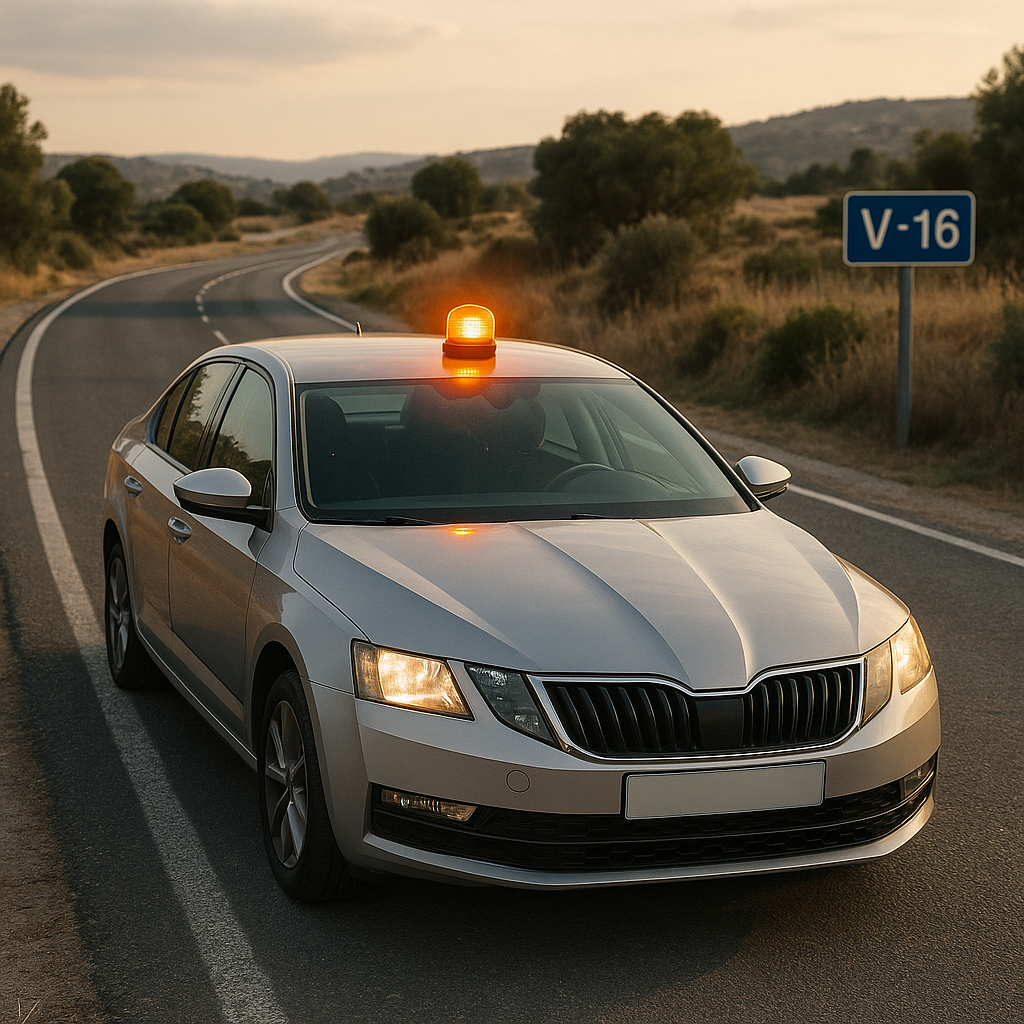
This page offers a list of important links to information about the V16 emergency light, also known as the V-16 pre-signaling device:
Contents of this V16 Hub Page
Understanding the V-16 Emergency Beacon: What Drivers Need to Know Before 2026
Spain is replacing warning triangles with the V-16 emergency beacon from 1 January 2026. This guide explains what the device is, how it works, and how to choose a certified, connected model.
Why the V-16 Is Replacing Warning Triangles
Walking along a live road to place warning triangles has caused many avoidable deaths in recent years. The V-16 emergency beacon removes that risk by allowing drivers to signal danger immediately, without leaving the vehicle.
A Connected Device Is Now Mandatory
Only connected V-16 beacons will meet legal requirements. Many cheaper models still being sold online are non-connected and will not be compliant. A legal beacon must transmit its location to DGT 3.0 using built-in communication hardware and long-term data.
Check for Official Certification
A compliant device must appear on the DGT’s list of certified models. This confirms that it has passed laboratory testing and meets the required physical, optical, and connectivity standards.
How the V-16 Works
When activated, the beacon emits a flashing yellow signal visible from up to one kilometre. It also sends its GPS position to DGT 3.0, allowing the vehicle to appear on national traffic maps and, where available, on motorway matrix signs.
Storage, Use, and Maintenance
The beacon should be kept in the glove box for rapid access. In an emergency, it is placed on the vehicle roof using a magnetic base. Test the battery regularly. Rechargeable models are acceptable if they can be charged inside the vehicle.
Limitations and Exceptions
The V-16 does not call emergency services or replace the SOS button. Motorbikes are not required to carry one, and foreign-registered vehicles may use the warning devices mandated in their home country.
Preparing for 2026
Choosing a certified, connected V-16 ensures compliance and improves safety for everyone on the road.
N332 Signpost – V-16 Emergency Lights (our pocket guide)
Download
You can download the N332 Signpost guide here to save on your device or print at home.
Kindle
Quick Bit
- The V-16 MUST be approved by the DGT
- ONLY the connected versions are legal from January
- They replace warning triangles
- Keep it in your glovebox
- The DGT approved connected V-16 is a MANDATORY REQUIREMENT
Importand Links
- DGT’s Official Guide
- DGT’s FAQ
- List of DGT approved v16 emergency beacons
- Amazon Options
- N332 Shop V-16 Category
- N332 First Explanatory Article
- N332 More Questions Answered
- N332 Motorbikes and the V-16
Videos
Frequently Asked Questions
We will add to this list as more questions come to light:
Data Protection Risks
Following a lot of incorrect speculation on social media, the Spanish Data Protection Agency issued a statement making it clear that no data is shared.
The translation is below the image.
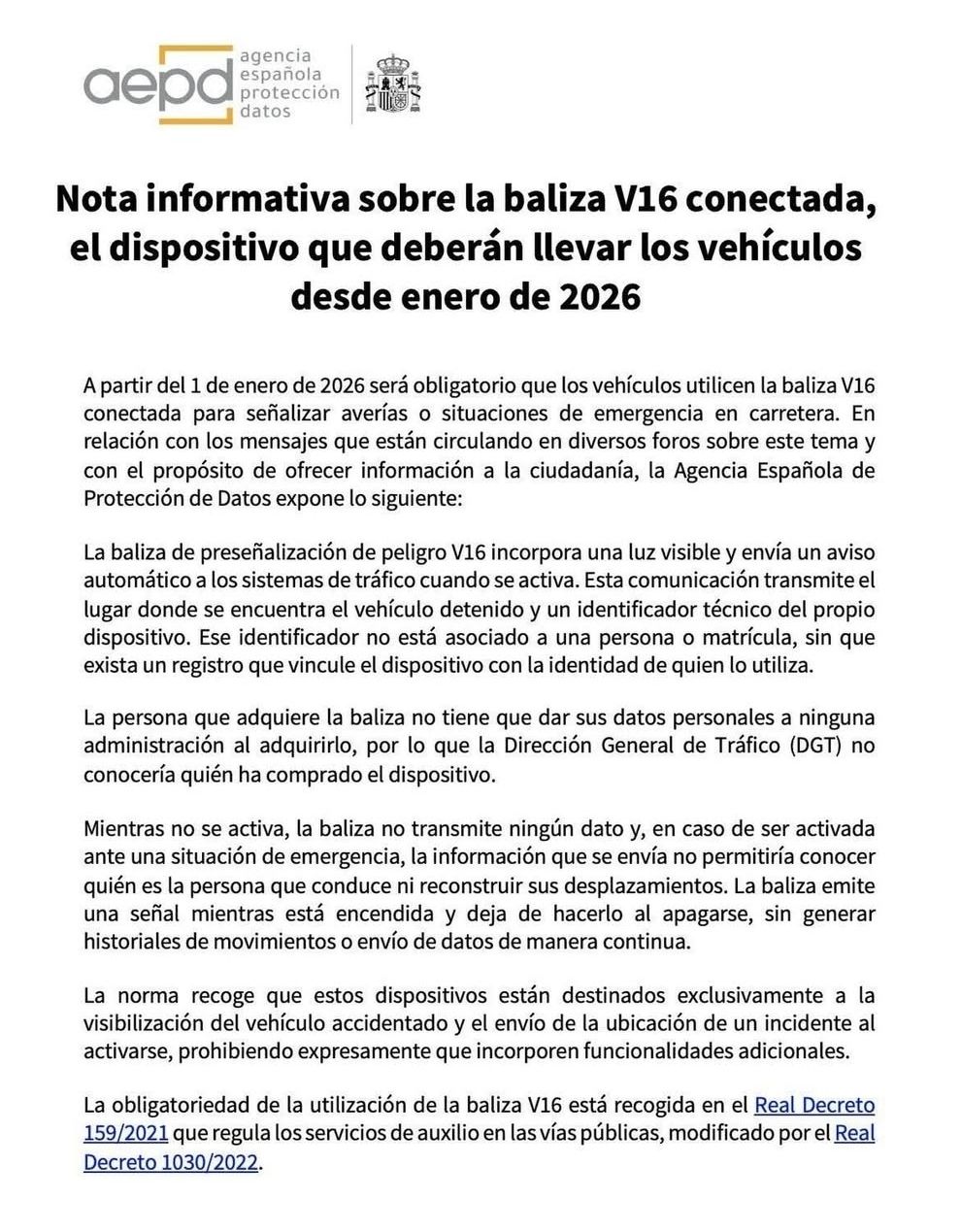
Information note on the connected V16 beacon, the device that vehicles will be required to carry from January 2026
From January 1, 2026, it will be mandatory for vehicles to use the connected V16 beacon to signal breakdowns or emergency situations on the road. Regarding the messages circulating in various forums on this topic and with the aim of providing information to the public, the Spanish Data Protection Agency states the following:
The V16 hazard warning beacon incorporates a visible light and sends an automatic alert to traffic systems when activated. This communication transmits the location of the stopped vehicle and a technical identifier of the device itself. This identifier is not associated with a person or license plate, and there is no record linking the device to the identity of the user
The person who acquires the beacon does not have to give their personal data to any administration upon purchase, so the Directorate General of Traffic (DGT) would not know who bought the device.
While not activated, the beacon does not transmit any data, and if activated in an emergency, the information sent would not allow the driver’s identity to be identified or their movements to be reconstructed. The beacon emits a signal while it is on and stops when it is turned off, without generating movement histories or continuously transmitting data.
The regulation states that these devices are intended exclusively for making the damaged vehicle visible and sending the location of an incident when activated, expressly prohibiting the incorporation of additional functionalities.
The mandatory use of the V16 beacon is established in Royal Decree 159/2021, which regulates roadside assistance services, as amended by Royal Decree 1030/2022
Amazon Link
Now you know everthing there is to know, you can browse Amazon if you wish, or other reliable shops.
You must be logged in to post a comment.