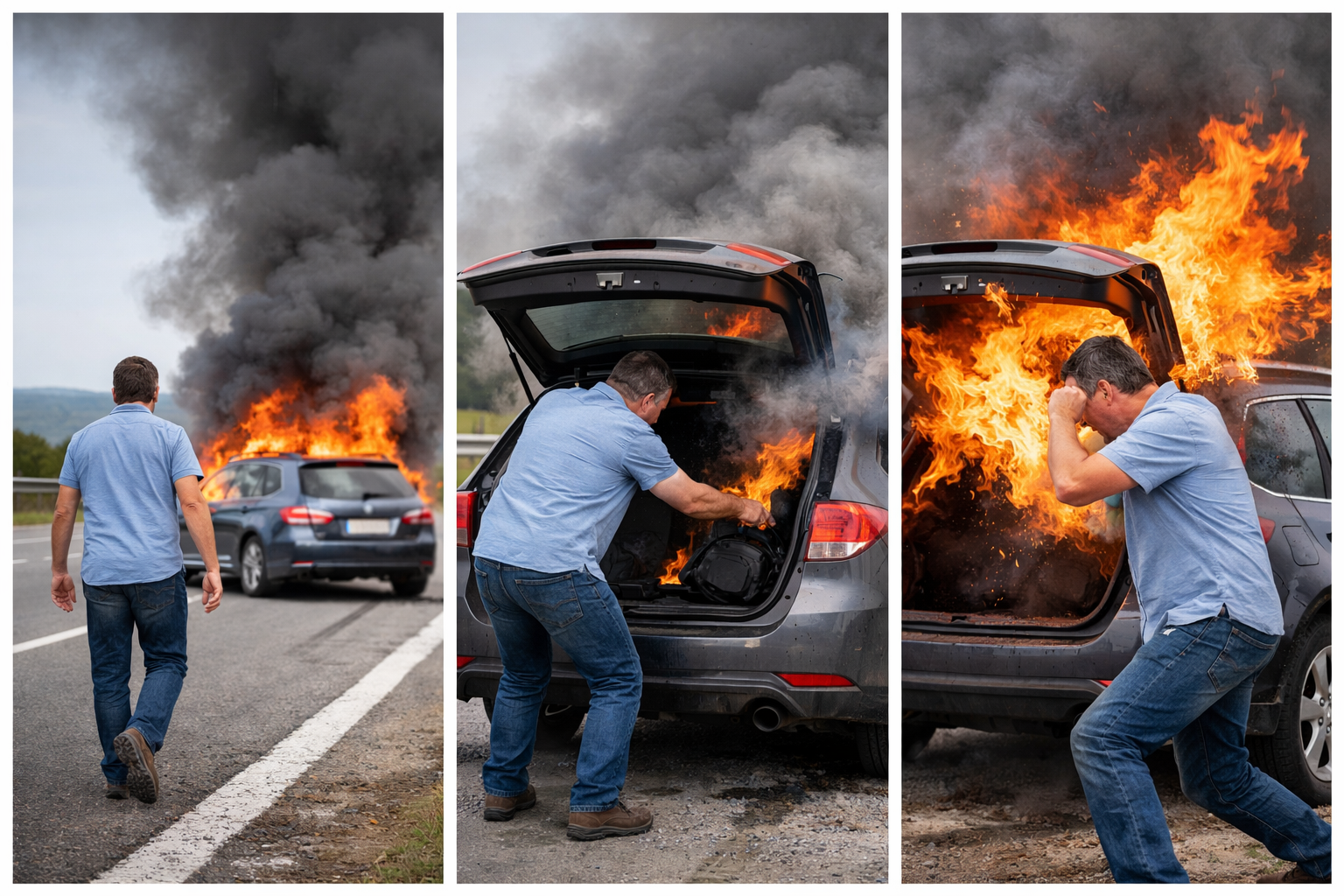

In any vehicle fire, the most important decision is also the simplest: get everyone out and move well away, immediately.
Fire develops quickly, and conditions can change in seconds. Remaining close to the vehicle—even briefly to retrieve belongings—exposes occupants to:
- Intense heat capable of causing burns at a distance
- Toxic smoke, including carbon monoxide and other harmful gases
- Sudden escalation, as materials ignite or components fail
- Secondary hazards, such as tyre bursts or airbag deployment
A safe approach is to move everyone at least 30 to 50 metres away, ideally behind a barrier or upwind, and then contact emergency services.
Everything else is secondary. Property can be replaced. People cannot.
Contents
Why you should not attempt to tackle a vehicle fire yourself
There is often a strong instinct to intervene, particularly if the fire appears small or manageable. However, attempting to extinguish a vehicle fire without the right equipment, training, and positioning can quickly make the situation worse.
1. Fire growth is faster than it appears
What looks like a small fire can already be well established:
- flames may only be visible in one area
- heat and fire spread may already be occurring behind panels
- materials such as plastics and insulation can ignite rapidly
A fire that seems controllable can escalate in seconds, placing the person attempting to fight it at immediate risk.
2. The wrong extinguishing method can worsen the fire
Water is the most obvious response, but in vehicle fires it is often ineffective or inappropriate in the early stages.
Vehicles contain:
- oils and fuels
- electrical systems
- synthetic materials
Using water can:
- spread burning liquids, particularly if fuel or oil is involved
- cause steam burns when it hits hot surfaces
- be ineffective against electrical components
In some cases, water can give a false sense of control while the fire continues to develop underneath.
3. Opening compartments feeds the fire
To tackle a fire, people often:
- open the bonnet
- open doors
- or open the boot
This introduces oxygen and can:
- intensify the fire immediately
- cause a flare-up towards the person
- accelerate fire spread through the vehicle
This is one of the most common ways people are injured when attempting to intervene.
4. Lack of correct equipment
Professional responders use:
- appropriate extinguishers (foam, powder, or specialised agents)
- protective clothing
- controlled techniques
Most drivers:
- do not carry the correct extinguisher
- may not know how to use it effectively
- are not protected from heat or smoke
Without these, the risks increase significantly.
5. Positioning and escape are critical
Firefighters are trained to:
- approach from safer angles
- maintain escape routes
- read fire behaviour
A member of the public is far more likely to:
- stand too close
- position themselves downwind of smoke
- become trapped by sudden changes in fire direction
The temptation to open the boot
Once outside the vehicle, it is entirely human to think about what is inside the boot—bags, documents, equipment, or personal items.
However, returning to the vehicle and opening the boot introduces a set of risks that are often underestimated.
This is not about one single danger, but a combination of factors that can rapidly increase the threat level.
Why opening the boot can make things worse
1. It delays evacuation and keeps you in the danger zone
The most immediate risk is still the most important:
- You remain close to a developing fire
- You lose valuable seconds or minutes
- You may be caught out by a sudden change in conditions
In real incidents, proximity and delay are the leading causes of injury.
2. Fire does not behave predictably — even when it looks contained
A vehicle may appear to be burning only at the front or within the cabin, but:
- Fire can travel behind panels and under trim
- Heat can build in enclosed spaces such as the boot
- Smoke may be present without visible flame
The absence of visible fire at the rear does not mean the area is safe.
3. Opening the boot can trigger a sudden flare-up
This is often misunderstood.
It is not typically a classic backdraft (as seen in building fires), because vehicle fires are usually already ventilated. However, a different and very real mechanism exists:
- Heat and flammable gases can accumulate inside enclosed areas
- Opening the boot introduces fresh oxygen
- The change in airflow can disturb and mix hot gases
The result can be:
- a rapid increase in flame intensity
- flames projecting outward towards the opening
- a sudden release of heat and smoke
This is more accurately described as ventilation-induced fire growth, and it can cause immediate injury to anyone standing at the rear of the vehicle.
4. The fire can be drawn towards you
When you open the boot:
- air is pulled into the vehicle
- flames may be drawn in the direction of that airflow
- the fire can effectively move towards the opening
This places the person opening the boot directly in the path of:
- flames
- hot gases
- radiant heat
5. Hidden hazards inside the boot
The boot area often contains items that can worsen the situation:
- luggage and fabrics that ignite easily
- pressurised containers (aerosols, cleaning products)
- tools or equipment that can fail under heat
Opening the boot can expose these items to oxygen, increasing the likelihood of rapid ignition or violent burning.
6. Fire spread towards the fuel system
As a vehicle fire develops, it may spread towards the rear, where key fuel components are located:
- the fuel tank (typically under the rear)
- the filler neck and associated pipework
While modern fuel tanks are designed to be robust and are unlikely to “explode” in the way often portrayed, sustained heat can:
- damage surrounding components
- lead to fuel leaks or vapour release
- significantly intensify the fire
Any action that increases fire intensity—such as opening the boot and introducing oxygen—can accelerate this process and make the situation more hazardous.
The reality: uncertainty is the danger
It is important to acknowledge:
Not every vehicle fire will behave in the same way.
Not every boot opened will result in a flare-up.
However, the critical issue is this:
- You cannot predict which incident will escalate
- You cannot see what is happening inside panels or compartments
- By the time a change becomes visible, it may already be too late
A clear and practical message
For road safety purposes, the guidance should remain simple and consistent:
- Stop the vehicle safely
- Get everyone out immediately
- Move well away from the vehicle
- Do not return to retrieve belongings
- Do not attempt to fight the fire
- Do not open the boot or any compartments
Final thought
In a vehicle fire, there is a natural instinct to act—to save possessions, to check, to intervene.
But safety comes from doing less, not more.
Distance, time, and restraint are what protect you.
Leave the vehicle. Stay away. Let trained professionals deal with what follows.
Discover more from N332.es - Driving In Spain
Subscribe to get the latest posts sent to your email.