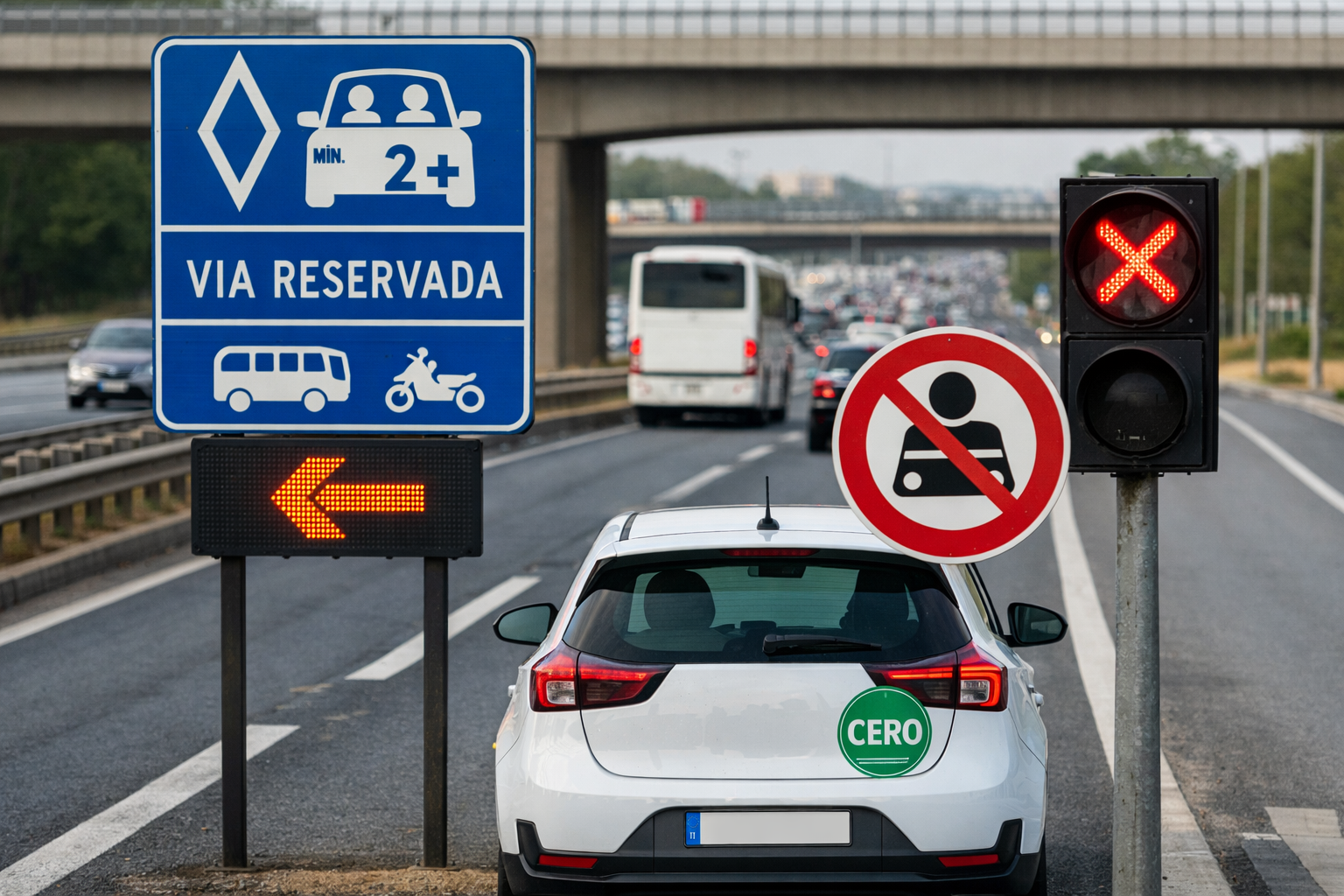

Spain’s national traffic authority has introduced a significant change to how high-occupancy vehicle (HOV) lanes will operate in 2026, removing the automatic privilege previously granted to zero-emission vehicles travelling with a single occupant.
The measure forms part of the Resolution of 14 January 2026 on special traffic regulation measures, recently published in the Boletín Oficial del Estado, and marks a clear shift in policy: vehicle occupancy now takes precedence over vehicle type or emissions classification.
Contents
Occupancy takes priority over emissions
Until now, passenger cars classified as zero emissions were permitted to use HOV lanes even when occupied only by the driver. From 2026, that exemption is removed.
Under the new rules, single-occupant cars will no longer have guaranteed access to HOV lanes, regardless of whether they carry a zero-emissions, ECO, C, or B environmental sticker. Access will instead depend on:
- The number of occupants in the vehicle
- Traffic conditions at the time of travel
- Fixed or variable message signs displayed at HOV lane entry points
In practice, this means that a zero-emission car with only one person on board may be excluded from HOV lanes during peak periods, in exactly the same way as a conventional vehicle.
Why the change has been introduced
According to Dirección General de Tráfico, the decision responds to sustained concerns from public transport operators, citizens, and the Ombudsman about the declining effectiveness of HOV lanes.
Traffic data shows that increased use of these lanes by single-occupant cars, including electric vehicles, has led to growing congestion. In some corridors, traffic volumes in Bus-HOV lanes have risen sharply since 2019, resulting in delays that directly undermine their core purpose: prioritising public transport and genuinely high-occupancy vehicles.
The revised approach is intended to restore reliability and punctuality for buses and shared transport, encouraging more efficient use of road space rather than rewarding vehicle technology alone.
Gradual and sign-led implementation
The change will not be applied as a blanket ban nationwide. Instead, it will be introduced progressively, depending on the characteristics and demand of each HOV lane.
HOV lanes will continue to operate only when explicitly activated by signage, and drivers will need to pay close attention to variable message signs, which will determine whether single-occupant vehicles of any type are permitted at a given time.
Motorcycles, buses, and vehicles meeting minimum occupancy requirements will continue to be prioritised, while trucks and mopeds remain excluded.
Where HOV lanes operate in Spain
HOV lanes affected by the regulation are located on key access corridors, including:
- The A-6 and A-2 in the Community of Madrid
- Routes in Granada, Seville, Málaga, Valencia, and Mallorca
All are subject to activation by fixed or variable signage and may apply different rules depending on traffic conditions.
A clear policy signal
While the Resolution also includes other seasonal and operational traffic measures for 2026, including restrictions linked to major events and adverse conditions, the HOV lane change stands out for its wider impact.
The message is clear: zero-emission status alone is no longer enough. In Spain’s busiest corridors, shared travel and public transport are now the primary criteria for priority road access.
Discover more from N332.es - Driving In Spain
Subscribe to get the latest posts sent to your email.