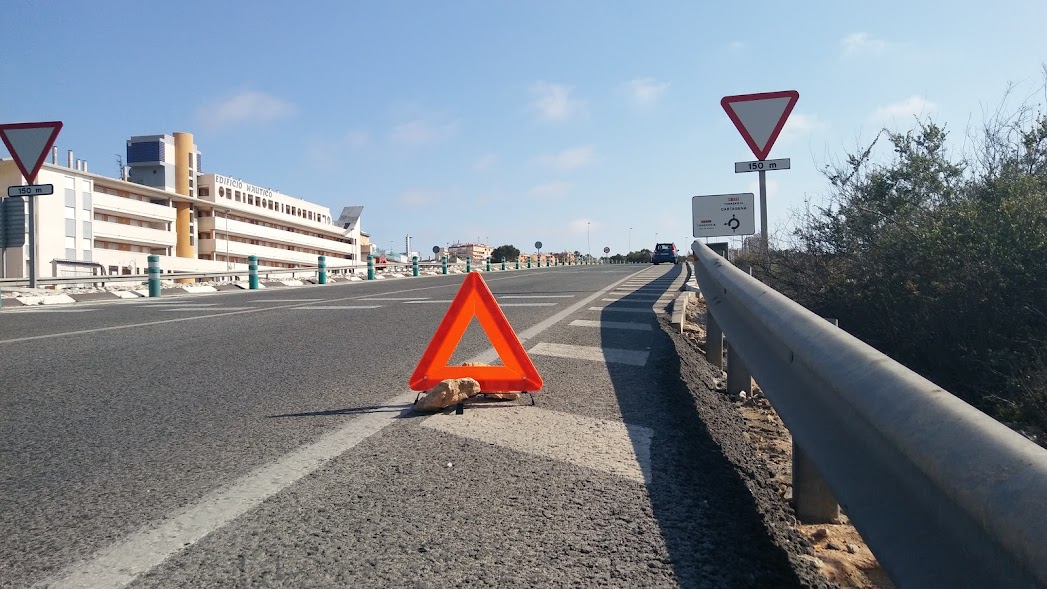

The introduction of the V-16 connected emergency beacon has generated significant debate, much of it emotional and highly polarised. To understand the device properly, it is essential to begin with the reason it exists at all.
The V-16 was not introduced to modernise road equipment, nor to satisfy technological ambition. It was introduced because people were dying. Hundreds of drivers who had suffered relatively minor incidents — a puncture, a mechanical warning, an overheating engine — were being killed while placing warning triangles on live roads. What should have remained an inconvenience became a fatal encounter, leaving devastation far beyond the roadside.
The intention of the V-16 is therefore simple: to remove the need for a person to step into danger in order to warn others of that danger.
One of the most common criticisms is that warning triangles provide better advance notice than a flashing beacon. Critics point to visibility and distance, sometimes using dramatic demonstrations involving damaged police vehicles to reinforce the message. Yet this argument often overlooks two uncomfortable truths.
The first is experiential. Drivers are rarely asked to reflect honestly on their own memory. Not abstractly, but personally. Think back one month, one year, ten years. When you have seen warning triangles in real use, were they correctly positioned? In the vast majority of real-world cases, they were not. Triangles are frequently placed close to the stranded vehicle, offering little or no advance warning at all. The theoretical protection of the triangle is undermined by the reality of human behaviour under stress.
The second truth is functional. The V-16 beacon is not merely a light. Its visible signal is only one layer of its purpose. Once activated, the beacon transmits the vehicle’s location to the DGT 3.0 platform, which then distributes that information to overhead matrix signs, traffic management systems, and digital mapping services. In effect, the warning travels far beyond the limits of human sight, reaching drivers long before any triangle or flashing light could possibly be seen.
This is a fundamentally different kind of advance warning — not dependent on perfect placement, clear sightlines, or ideal conditions. It is systemic, automatic, and distance-agnostic.
Much of the criticism circulating online, particularly from UK-trained drivers, reveals another layer of misunderstanding. These drivers often compare the V-16 unfavourably to systems they believe exist elsewhere. Yet the reality is simple: the UK has no equivalent system at all. There is no connected warning platform, no roadside alert integration, and no mandatory visual warning device. By comparison, Spain’s approach offers more protection, not less.
More telling still is what this criticism reveals about forgotten fundamentals. In the UK Highway Code, Rule 126 states that a driver must travel at a speed that allows them to stop well within the distance they can see to be clear. This principle is not optional. It is foundational. A driver who is observant and travelling at an appropriate speed should not require additional warning to avoid a stationary vehicle beyond a bend — because they should already be able to stop safely.
This same principle applies on Spanish roads.
When critics argue, “You come around a bend and you are on top of the car before you see the beacon,” the response is not technological — it is behavioural. If that happens, the driver was already travelling too fast for the conditions. The argument collapses entirely when we acknowledge three realities: triangles are rarely placed correctly, the V-16 provides warnings far earlier through connected systems, and correct speed selection removes the danger altogether.
Whether drivers choose to ignore warnings — visual, digital, or otherwise — is a separate issue. But misuse or disregard does not invalidate the purpose of a system designed to reduce risk where human behaviour has repeatedly failed.
The V-16 debate ultimately reveals not a failure of technology, but a failure of understanding. Social media amplification, selective examples, and confirmation bias have fuelled a narrative that ignores both the behavioural realities of triangle use and the advantages of connected warning systems.
As with so many safety measures, the question is not whether the device is perfect. It is whether we are willing to understand why it exists, what problem it addresses, and how our own behaviour determines its effectiveness.
Discover more from N332.es - Driving In Spain
Subscribe to get the latest posts sent to your email.