
Electric scooters are now an ordinary sight on Spanish streets.
They are used to get to work.
To shops.
To public transport.
And, increasingly, to school.
Their convenience is obvious.
They are small, relatively inexpensive to operate and can make short journeys much easier.
But their growing popularity also means that the rules surrounding them need to be understood.
And from 1 October 2026, some important national requirements change.
Fifteen becomes the national minimum age
The new national rules establish 15 years as the minimum age for driving a vehicle of personal mobility.
That creates a clear national baseline.
For parents, however, the important question is not simply whether a child has reached that age.
It is whether they are actually ready to use a vehicle in traffic.
Age is one factor.
Judgement is another.
Understanding traffic.
Recognising hazards.
Controlling speed.
Knowing when not to proceed.
These are skills that matter every bit as much.
Helmets become mandatory
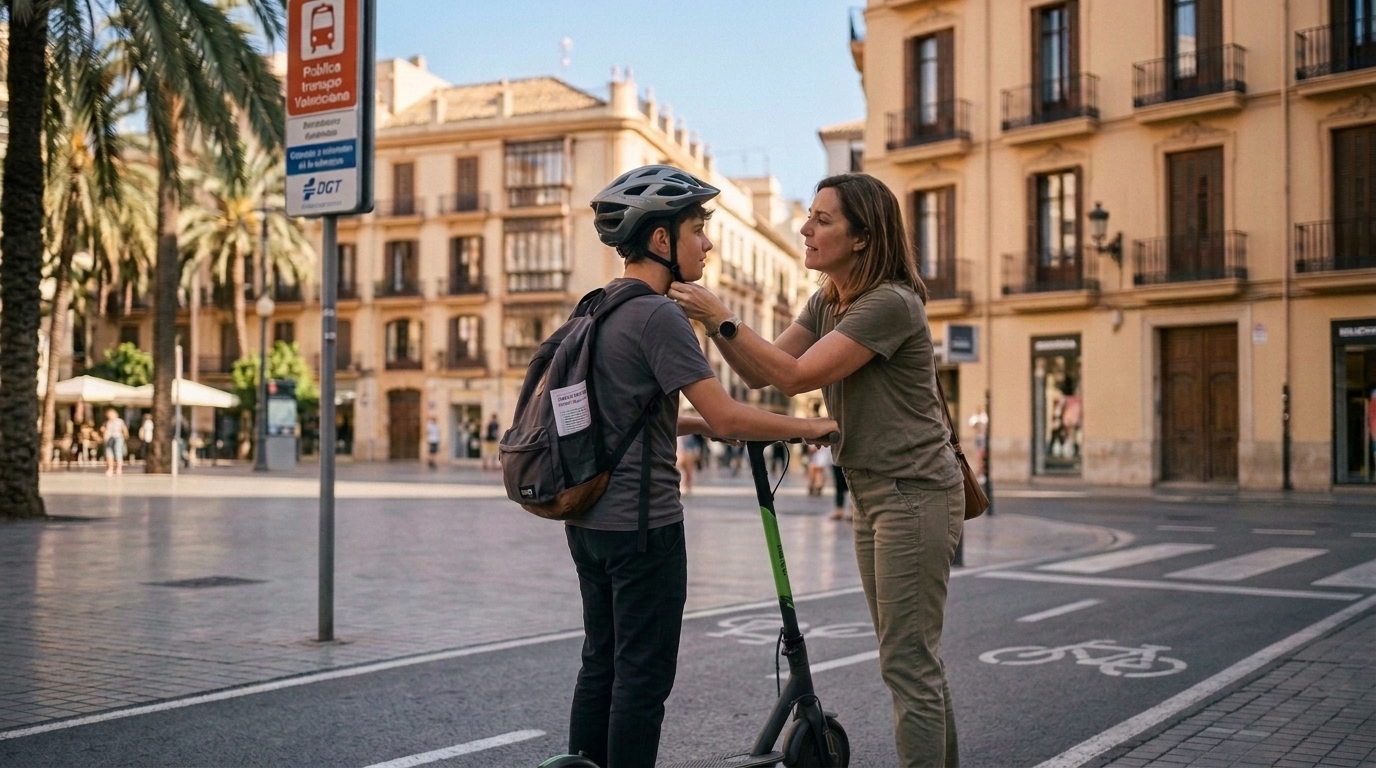
From 1 October, VMP users must wear a protective helmet. The DGT identifies this as one of the principal changes introduced by the reform.
For parents, this should not be viewed simply as another legal requirement.
It is a practical recognition of the vulnerability of somebody travelling on a small vehicle without the protection surrounding a car occupant.
A helmet cannot prevent every injury.
But it can provide important protection when a rider falls or is involved in a collision.
Insurance is already part of the picture
VMP users should also understand that this is not an unregulated form of personal transport.
The legal framework introduced compulsory insurance for VMPs, and the registration system now provides a way of identifying them. The DGT currently explains that VMPs must be registered and carry their identification plate in order to circulate.
That is an important change in perception.
An electric scooter is not simply something you pick up and ride.
It is a vehicle being used in a shared traffic environment.
Visibility still matters
The new rules also require VMP users to wear a reflective vest at night or in conditions of reduced visibility, with professional VMP users required to wear one at all times.
This makes sense from a safety perspective.
Being visible is one of the simplest ways to reduce the chance of another road user failing to see you.
It is worth remembering, however, that the separate mandatory lighting provision for VMPs does not take effect until 1 October 2027.
That distinction matters because good information is only useful if it is accurate.
Parents still have an important role
A new national minimum age does not mean that every 15-year-old is automatically ready to navigate traffic independently.
Parents should consider the child’s judgement and experience.
Can they understand priority?
Can they recognise hazards?
Do they know where they are permitted to ride?
Can they control the vehicle confidently?
Do they understand that pedestrians and other vulnerable road users also need protection?
These are questions worth asking before handing over the keys, or rather, the handlebars.
The scooter is not a toy
This may be the most important lesson of all.
A VMP can reach 25 km/h.
That may not sound fast when compared with a car.
But falling from a scooter at that speed can cause serious injury.
And the rider shares space with vehicles that are considerably larger and heavier.
The consequences of a mistake can therefore be significant.
Good habits begin before the first journey
Parents can help by travelling with their child initially.
Observe how they behave at junctions.
Watch whether they look properly.
See how they respond to pedestrians.
Check that they understand where they can and cannot ride.
Discuss what happens when something unexpected occurs.
The aim is not to frighten them.
It is to prepare them.
Rules are the minimum
A law establishes what is required.
Good judgement goes further.
A responsible rider does not ask only:
“Am I allowed to do this?”
They also ask:
“Is this safe?”
That distinction matters particularly with newer forms of mobility.
Electric scooters are here to stay.
The challenge is making sure the people using them understand that modern mobility brings modern responsibility.
From October, the legal requirements become clearer.
For parents and young riders, that should be the beginning of the conversation, not the end.
Discover more from N332.es - Driving In Spain
Subscribe to get the latest posts sent to your email.