
TL;DR: As daylight hours shorten in autumn and winter, pedestrians walking along roads or hard shoulders outside populated areas between sunset and sunrise must comply with Spanish traffic law by wearing approved retro-reflective or luminous gear visible from at least 150 metres away, ensuring drivers have sufficient time and distance to prevent severe collisions.
With the arrival of autumn and the change in daylight hours, evening falls much earlier, significantly increasing the risks for people walking along roads and hard shoulders. Pedestrians remain the most vulnerable road users on the network, and when darkness falls, their safety depends entirely on how early drivers can detect them.
Without reflective gear, a pedestrian walking in dark clothing at night is practically invisible until an approaching car is dangerously close. At standard driving speeds, that very short distance leaves motorists with almost no time to react, brake, or steer clear, creating critical hazards that lead directly to people being hit.
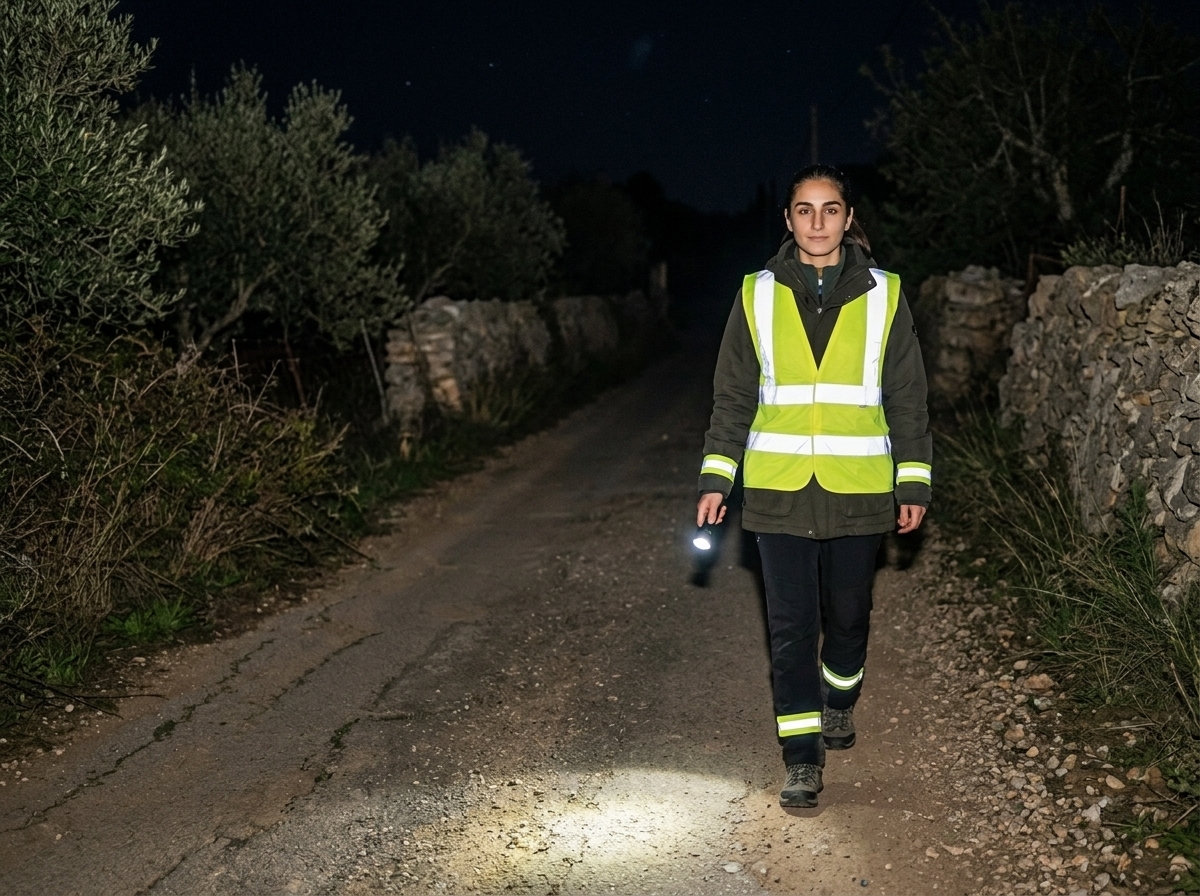
To combat this danger, Spanish traffic law sets out explicit legal obligations for pedestrians outside populated areas. Under the regulations governing movement at night (Article 123 of the General Traffic Regulations), between sunset and sunrise, or during adverse weather and environmental conditions that significantly reduce visibility, every pedestrian moving along a road or hard shoulder outside built-up areas must be equipped with an approved luminous or retro-reflective element.
This protective gear must comply with the technical standards established in Royal Decree 1407/1992 of 20 November, which regulates personal protective equipment. Crucially, the law specifies that this element must be clearly visible to approaching motorists from a minimum distance of at least 150 metres.
Specific provisions also apply to pedestrian groups. When a group of walkers is led by a person or moves as an organised cortege or procession, they must carry additional lighting on the side closest to the centre of the road to define their location and overall dimensions. These lights must show white or yellow illumination towards the front and red light towards the rear, which may be integrated as a single lighting set.
Using a simple reflective band, sash, or vest transforms your visibility. Instead of appearing as an unexpected shadow at the final split second, an approved reflective element picks up vehicle headlights hundreds of metres away, giving drivers ample distance to see you, adjust their speed, and move forward safely. As the darker months set in, making yourself visible is not just common sense; it is a vital legal requirement that saves lives.
Discover more from N332.es - Driving In Spain
Subscribe to get the latest posts sent to your email.