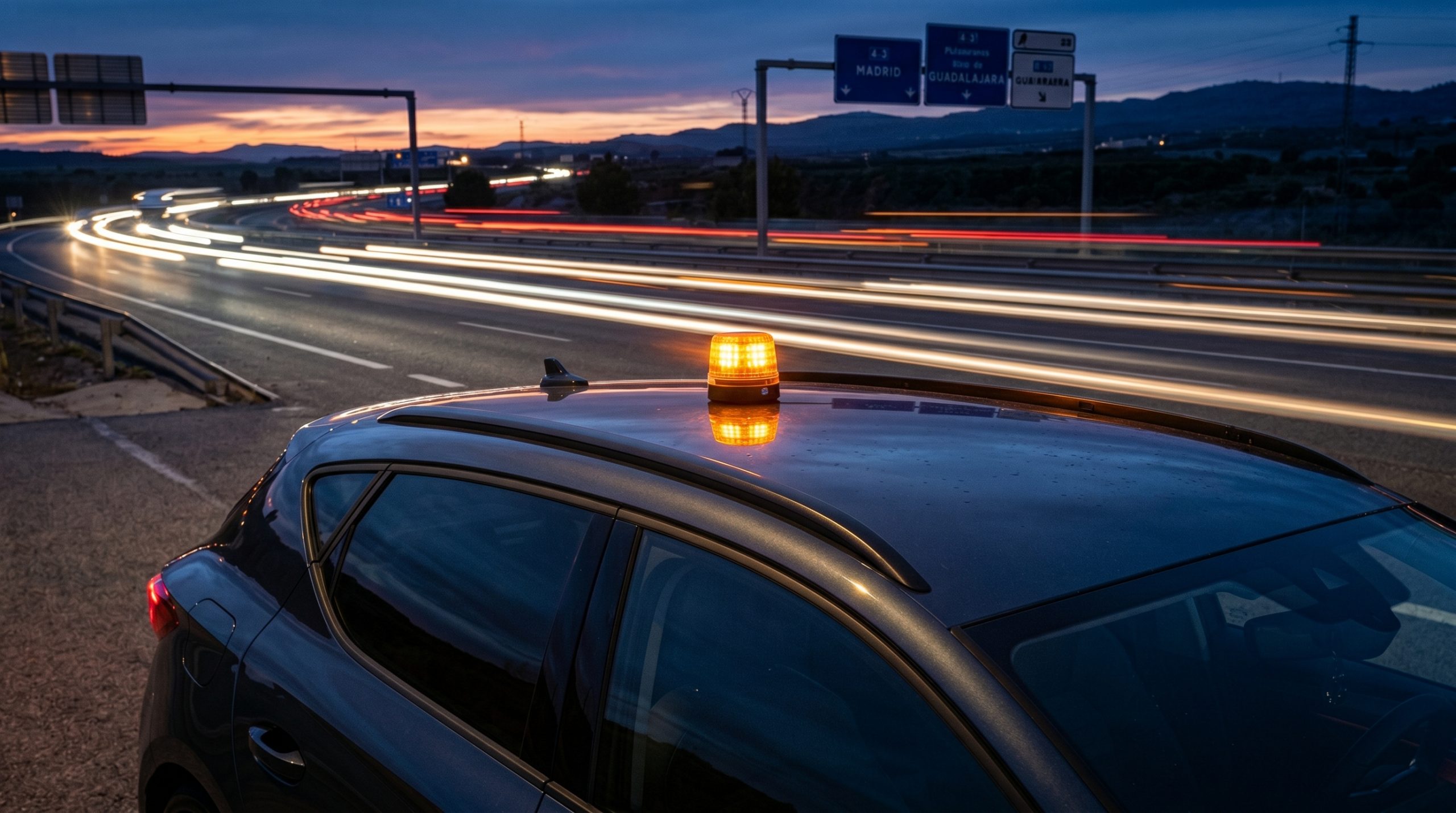

For decades, the plastic, reflective warning triangle has been a staple of emergency car kits across Europe. However, as traffic density increases and digital distractions rise, this vintage piece of safety equipment has transformed from a life-saver into a lethal hazard. With Spain officially executing strict enforcement and now issuing fines for non-compliant emergency signals, data from ROADPOL (the European Roads Policing Network) reveals the undeniable safety mechanics behind why warning triangles are being phased out in favour of the connected V-16 emergency beacon.
Under traditional traffic laws, if your vehicle breaks down on a dual carriageway or motorway, you are required to walk at least 50 metres behind your car to position a warning triangle. Where traffic flowed in both directions, you had to repeat the process to the front of the vehicle. Moreover, the triangle had to be visible for at least 100 metres at each end, so a bend or a brow of a hill increased the distance, and the risk, in an already risky location. On paper, this warns approaching motorists. In reality, it forces a driver to become a highly vulnerable pedestrian on a live road.
ROADPOL’s extensive road casualty audits continuously highlight a sobering reality: motorways account for roughly 8% of all European traffic fatalities, but a shocking percentage of those deaths do not involve vehicles colliding at high speed — they are stranded motorists hit while standing on the hard shoulder or setting up warning gear. Spain first dropped the mandatory requirement to use triangles on motorways for this exact reason. Walking down a live motorway shoulder is so hazardous that European safety researchers estimate the average survival window of an unprotected pedestrian in that environment is less than 20 minutes.
Why is walking the hard shoulder so dangerous? It comes down to a dangerous cognitive phenomenon known to traffic psychologists as target fixation or visual capture. When a driver becomes fatigued, micro-sleeps, or glances down at a mobile phone, or at a passenger, their steering wheel subconsciously follows their eyes. If a driver looks at a pedestrian walking along the edge of the asphalt, they inadvertently steer directly toward them. By walking down the shoulder to place a triangle, you are effectively turning yourself into a visual target for a distracted driver.
Spain’s mandatory, connected V-16 beacon completely eliminates this human vulnerability by removing the requirement to exit the vehicle to signal danger. The beauty of the V-16 system lies in its instant execution. First, it requires zero foot traffic. You simply wind down the window, reach up, and magnetically attach the beacon to your roof. You and your passengers remain shielded inside the vehicle cabin or safely behind the steel crash barriers.
Second, it provides a digital early warning. The moment the beacon is activated, its integrated eSIM flashes your precise GPS coordinates directly to the DGT 3.0 traffic cloud. This does not just warn the drivers who can physically see you — it instantly updates navigation apps like Google Maps and Waze, alongside electronic highway gantries, warning oncoming traffic kilometres before they even approach your breakdown zone.
As traffic units across Spain clamp down on unapproved or non-functioning units, motorists must realise that carrying a V-16 beacon is not just about avoiding a 80 euro fine. It is about aligning with modern European data-driven policing. The warning triangle belongs to a bygone era of motoring. By moving the warning signal to the roof and broadcasting it digitally through the cloud, we protect our most vulnerable asset on the road: ourselves.
Discover more from N332.es - Driving In Spain
Subscribe to get the latest posts sent to your email.