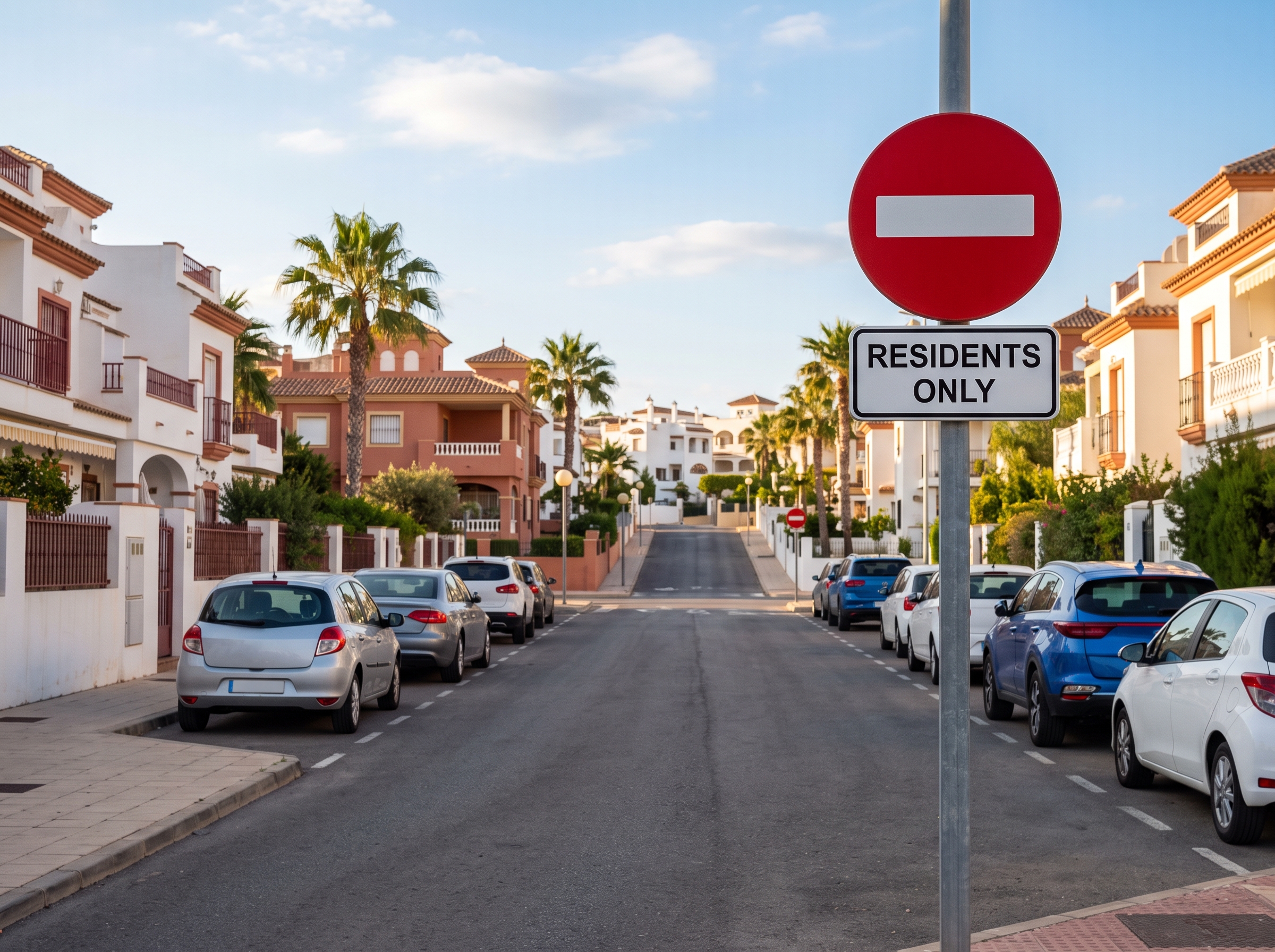
A persistent misconception across Spanish residential communities and urbanisations suggests that owning a private road permits residents to bypass national traffic laws or invent their own motoring regulations, but statutory road safety rules still apply wherever land is accessible to an indeterminate community of users. Under Spanish traffic legislation, private property open to collective traffic—such as supermarket car parks or communal residential developments—requires full adherence to core safety mandates, including compulsory seatbelt use, mobile phone prohibitions, valid driving licences, up-to-date insurance, and a passed ITV inspection.
There is an enduring myth circulating across many communities and urbanisations in Spain concerning the legal status of a “private road”. While the physical tarmac and the underlying land may indeed belong to private owners, a private company, or a community of neighbours, this ownership status does not mean that statutory road traffic law ceases to exist. Crucially, it also does not grant residents or administrators the authority to make up or alter their own driving rules.
The scope of the law is clearly defined. In the English translation of Spanish traffic law published on spanishtrafficlaw.es, the regulation outlines the precise reach of these legal obligations across the national territory:
“In general, the traffic laws, movement of motor vehicles and road safety matters contained both in this regulation and other relevant provisions elsewhere, will be applicable throughout the national territory. They will apply to owners and users of roads and public land suitable for traffic circulation, both urban and interurban, as well as those roads and land that are in common use and in the absence of other rules, to those of private roads and land that are used by an indeterminate community of users.”
To understand how this operates in daily life, motorists must recognise what constitutes “commonly used roads and land”. This definition refers directly to spaces open to the free movement of vehicles. Any track or carriageway carrying such circulation remains entirely subordinate to the Road Safety Law. Consequently, every motor vehicle entering these spaces must have passed the official ITV technical inspection, hold active insurance, and be operated by an individual holding a valid driving licence corresponding to that specific category of vehicle. Many motorists fall into the trap of assuming that unpaved rural tracks lacking asphalt or formal traffic signs are immune to road safety enforcement, only to face strict penalties for failing to wear a seatbelt or for using a mobile phone at the wheel.
A vital legal distinction also hinges on the phrase “indeterminate community of users”. This terminology applies whenever access to private land extends beyond the sole private owner to include other members of the public or third-party motorists.
A clear example of this principle is a supermarket car park, such as that of Carrefour. While Carrefour holds private ownership of the physical premises, the retail chain keeps the facility open for its customers to use. That customer access transforms the area into private land used by an indeterminate community of users, bringing vehicle circulation directly under the remit of national traffic legislation.
By contrast, where land is restricted exclusively to specific property owners—such as an enclosed residential garage facility where only designated neighbours hold access—the space is categorised under common use rather than unrestricted public access. Nevertheless, whenever access is open to a wider group of road users, private ownership cannot be used as an excuse to ignore the law. The statutory rules of the road remain fully in force.
Discover more from N332.es - Driving In Spain
Subscribe to get the latest posts sent to your email.