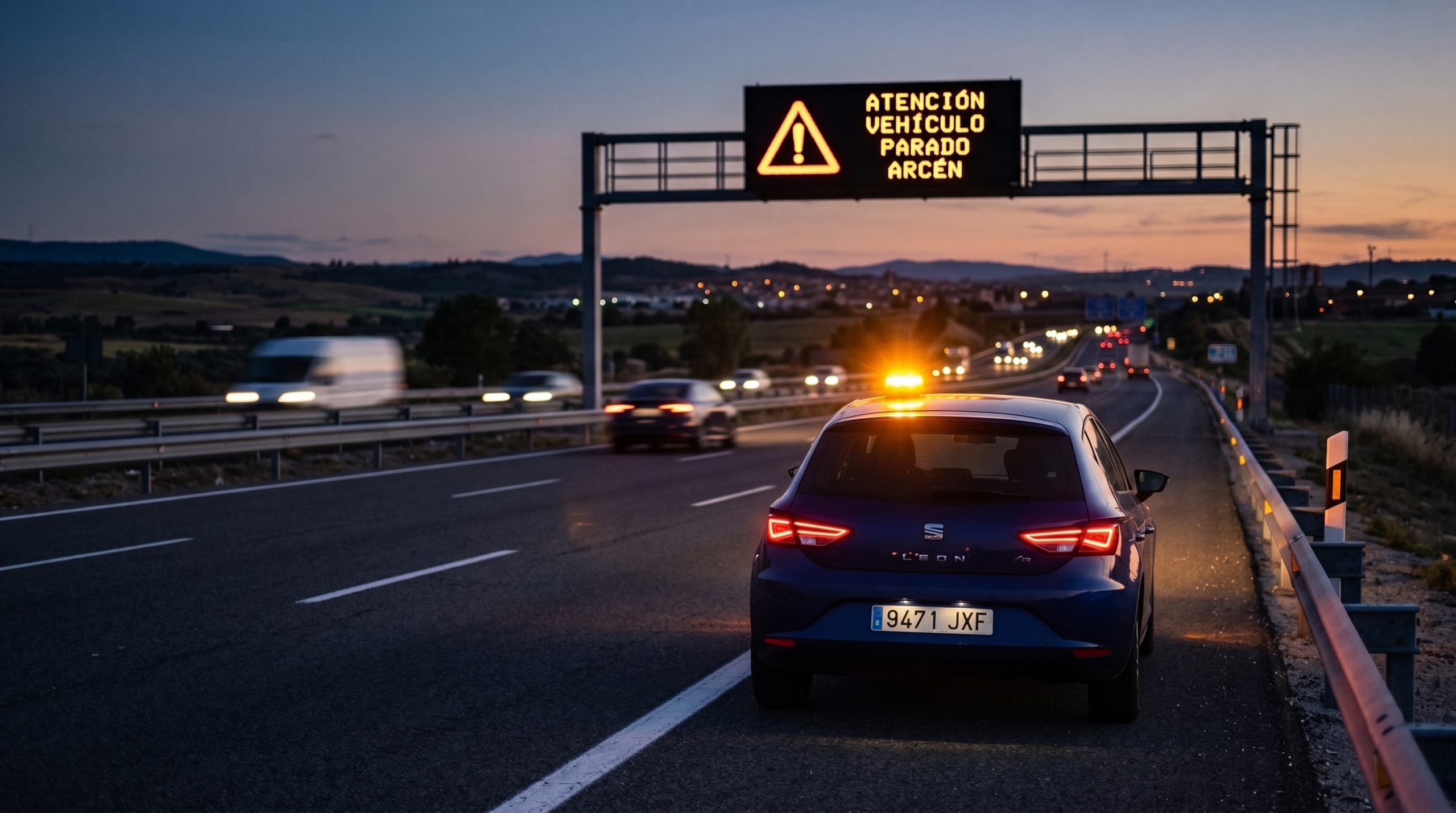

With Spain’s annual Operación Retorno bringing more than 100 million summer road journeys to a close, traffic authorities have begun auditing the telemetry of the busiest driving season of the year. For the Agrupación de Tráfico de la Guardia Civil and the Dirección General de Tráfico (DGT), the summer of 2026 stood out for a pivotal reason: it was the first peak holiday exodus conducted under the full, mandatory enforcement of connected V-16 emergency beacons.
Initial compliance audits reveal not only widespread adoption of the devices across Spanish-registered vehicles, but a direct, measurable reduction in secondary roadside pedestrian collisions on high-speed motorways (autovías and autopistas).
The data confirms what road safety analysts have argued for years: taking the driver off the tarmac saves lives.
Contents
Eliminating the Fatal Fifty Metres
For decades, the standard European procedure following a breakdown or collision was dangerous by design. Motorists were required to put on a reflective vest, step out into live traffic, open the boot, assemble physical warning triangles, and walk down the hard shoulder or carriageway to position them at least 50 metres behind the vehicle.
On unlit single-carriageway routes or high-speed arterial corridors like the AP-7 and A-7, this protocol repeatedly proved fatal. Prior to the full transition, dozens of pedestrians were killed or severely injured each year across Spain simply trying to deploy warning triangles.
The connected V-16 device was engineered to eliminate this hazard entirely:
- Zero Footfall on the Tarmac: The magnetic, amber-flashing beacon is designed to be kept inside the glove compartment. In the event of an incident, the driver simply opens the window and attaches the unit to the vehicle’s roof or exterior metal frame without ever stepping outside into live lanes.
- Instant 360-Degree Visibility: Once positioned, the beacon emits a high-intensity flashing amber light visible for at least one kilometre, even in bright midday glare or adverse weather.
How the DGT 3.0 Platform Closes the Information Gap
Physical visibility is only half of the technology. The legal mandate that took full effect on 1 January 2026 requires that every V-16 beacon carried in Spanish-registered vehicles must be certified and connected.
[ Broken-down Vehicle ]
         │
         ▼ (Automatic Activation on Vehicle Roof)
[ Connected V-16 Beacon ]
         │
         ▼ (Encrypted Cellular M2M Signal / GPS)
[ DGT 3.0 Cloud Platform ]
         │
         ├──► Variable Message Signs (VMS Gantries)
         ├──► Connected Navigation Apps (Real-Time Hazard Alerts)
         └──► In-Dashboard Digital Warnings (V-27 Virtual Triangle)
The moment the beacon is activated, its internal Narrowband-IoT (NB-IoT) or LTE-M chip establishes an autonomous connection with the DGT 3.0 central cloud. It transmits precise GPS coordinates every 100 seconds without requiring any pairing with the driver’s mobile phone or any monthly subscription fees.
This automated transmission instantly triggers three protective layers:
- Gantry Alerts: Nearby overhead Variable Message Signs (paneles de mensaje variable) automatically update to display breakdown warnings to approaching traffic.
- Navigation Warnings: The data feed pushes directly into connected navigation apps and navigation platforms, notifying motorists kilometres in advance of a stationary vehicle ahead.
- The V-27 Virtual Triangle: On modern connected vehicles, the hazard warning appears directly on the digital dashboard interface as a virtual safety triangle (Señal V-27), alerting drivers to slow down long before the physical vehicle comes into view around a blind bend.
Crucially, the system protects driver privacy. The SIM card integrated into the certified beacon remains dormant until the physical switch is engaged. No movement tracking, speed monitoring, or identity data is ever transmitted; only the emergency coordinates and the beacon’s unique certification ID are sent to the traffic management centre.
Summer Compliance Audits: What the Patrols Found
According to field reports from the Guardia Civil, compliance rates throughout July and August remained remarkably high, particularly among domestic motorists and commercial fleets navigating coastal arteries such as the N-332, AP-7, and A-3 corridors.
Roadside officers noted that broken-down vehicles displaying an active V-16 beacon allowed maintenance teams and emergency services to reach immobilized cars much faster. Because exact geolocation coordinates hit traffic control rooms within seconds of breakdown, tow trucks and patrol units were dispatched directly to the correct kilometre marker without the confusion and delayed response times associated with panicked mobile phone calls.
More importantly, emergency services reported a sharp drop in panic-induced pedestrian wandering. With drivers instructed to remain belted inside their vehicle behind locked doors while waiting for assistance, secondary impact casualties along primary interurban networks dropped noticeably compared to the same period in 2024 and 2025.
Key Reminders for Drivers
While compliance has been praised by traffic directors, regional consumer bodies and motoring organizations continue to clarify a few persistent misconceptions:
- Vehicle Scope: The legal obligation to carry and deploy a connected V-16 beacon applies to all Spanish-registered passenger cars, vans, buses, and commercial vehicles.
- Foreign-Registered Vehicles: Vehicles visiting Spain on foreign registration plates (such as UK, Irish, French, or German plates) are not legally required to carry a connected V-16 beacon and may continue to use standard warning triangles complying with international conventions. However, the DGT strongly recommends foreign motorists adopt approved beacons for their own personal safety.
- Motorcycles: Two-wheelers are exempt from the mandatory requirement due to storage limitations, though small, rechargeable V-16 units are highly encouraged.
- Certified Hardware Checks: Drivers are reminded to verify that their device is officially certified by the DGT. Non-connected beacons purchased before the 2026 mandate are no longer legally valid. An official unit displays an indelible certification code on its casing (typically formatted with laboratory identifiers such as LCOE or IDIADA) and includes a minimum of 12 years of prepaid connectivity from the date of purchase.
Discover more from N332.es - Driving In Spain
Subscribe to get the latest posts sent to your email.