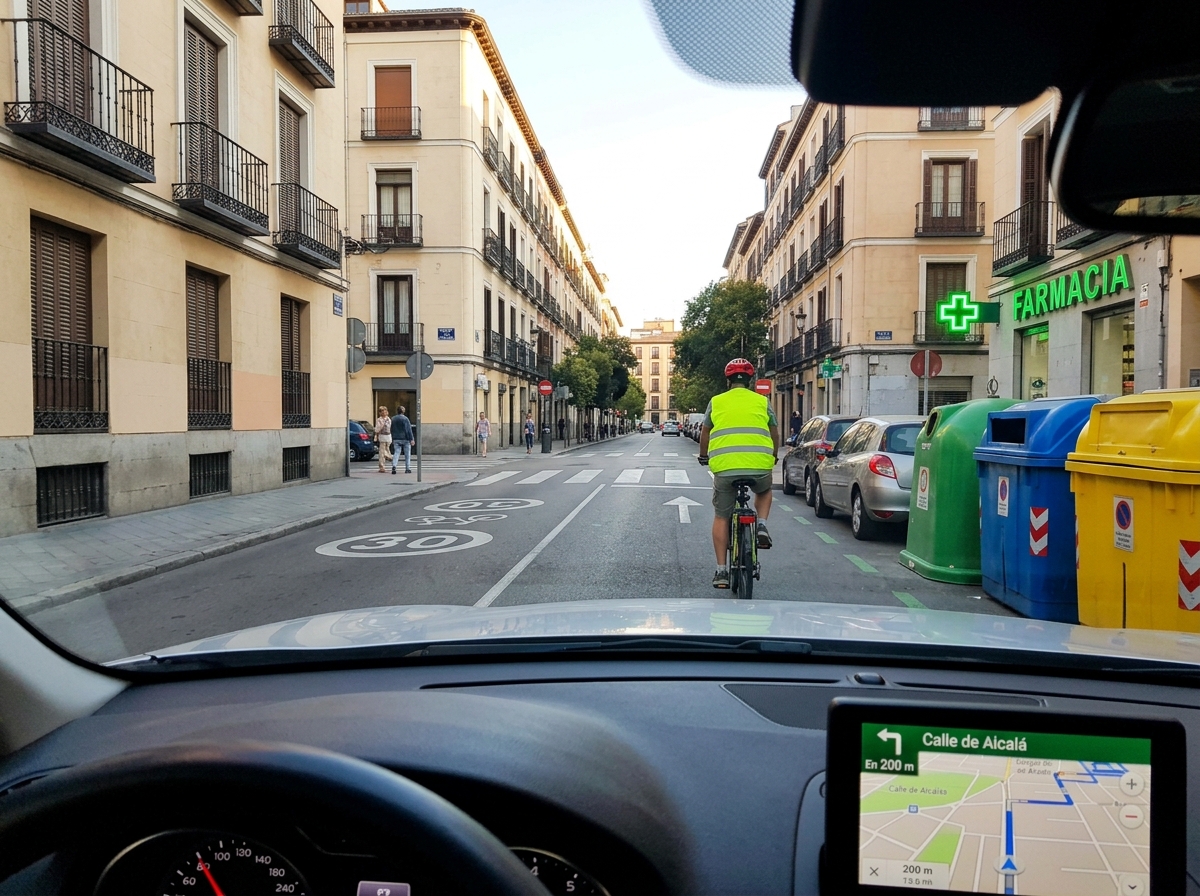

TL;DR: Following legal changes that came into force on 1 October, drivers in urban areas must now maintain a minimum safety distance of 5 metres when following behind cyclists, who are encouraged to take the centre of the lane for safety, alongside Spain’s established general and out-of-town vehicle separation requirements.
Recent updates to Spanish traffic regulations that came into active effect on 1 October have introduced specific safeguards for vulnerable road users in built-up areas. Under these updated rules, motor vehicles driving behind a bicycle in towns are now required to maintain a distance of at least 5 metres from the cyclist.
Alongside this mandatory clearance, cyclists in urban environments are now actively encouraged to ride in the centre of the traffic lane. Positioning in the middle of the lane significantly improves the cyclist’s visibility to motorists behind and ahead. Furthermore, it creates essential buffer space that allows riders to steer around everyday street hazards safely, including drain grids, potholes, crossing pedestrians, and vehicle doors opening unexpectedly from parked cars.
While this 5-metre rule provides a defined measurement for urban cycling scenarios, it works alongside the overarching distance regulations that govern all vehicles on Spanish roads. Under general traffic law, every driver travelling behind another must maintain a clear space ahead that permits them to stop safely in the event of sudden braking, without colliding with the vehicle in front. This separation must take into account prevailing vehicle speed, road grip, and braking conditions. The only exception to this standard gap is granted to bicycle riders travelling in a group, who may ride together without maintaining this individual gap provided they leave enough space to avoid colliding with one another.
On the road, the principle behind safe following distance is practical and absolute: as a general rule, if you strike a vehicle from behind, you will be held responsible for the collision. Drivers must always leave sufficient space to react and manoeuvre should the vehicle ahead brake abruptly. A sudden stop can be triggered at any moment by an unexpected hazard, such as an animal running into the road, a child stepping out, an obstruction on the carriageway, or an unfolding traffic incident. Colliding with the rear of another vehicle serves as clear demonstration that an adequate safety margin was not maintained.
Outside of towns, an additional separation requirement applies. Any driver following another vehicle without indicating an intention to overtake must maintain a sufficient distance to allow a third vehicle to overtake and safely pull into the gap between them. Cyclists riding in a group are exempt from this requirement. However, for heavier transport—specifically vehicles with a maximum authorised mass exceeding 3,500 kilograms, as well as vehicle combinations and joined vehicles longer than 10 metres—drivers must leave a dedicated minimum separation of 50 metres for this purpose.
Drivers should note that this specific overtaking-clearance rule does not apply in four distinct circumstances:
- In towns.
- On stretches of road where overtaking is strictly prohibited.
- Where there is more than one lane designated for traffic moving in the same direction.
- When traffic volume is heavily saturated and conditions do not allow overtaking.
Failing to maintain these mandatory following distances is not treated lightly under Spanish road safety legislation. Infractions of these separation rules are officially classed as serious offences. Maintaining disciplined following distances both in town and on the open road protects all road users and ensures you have the necessary time and space to react to the unexpected.
Discover more from N332.es - Driving In Spain
Subscribe to get the latest posts sent to your email.