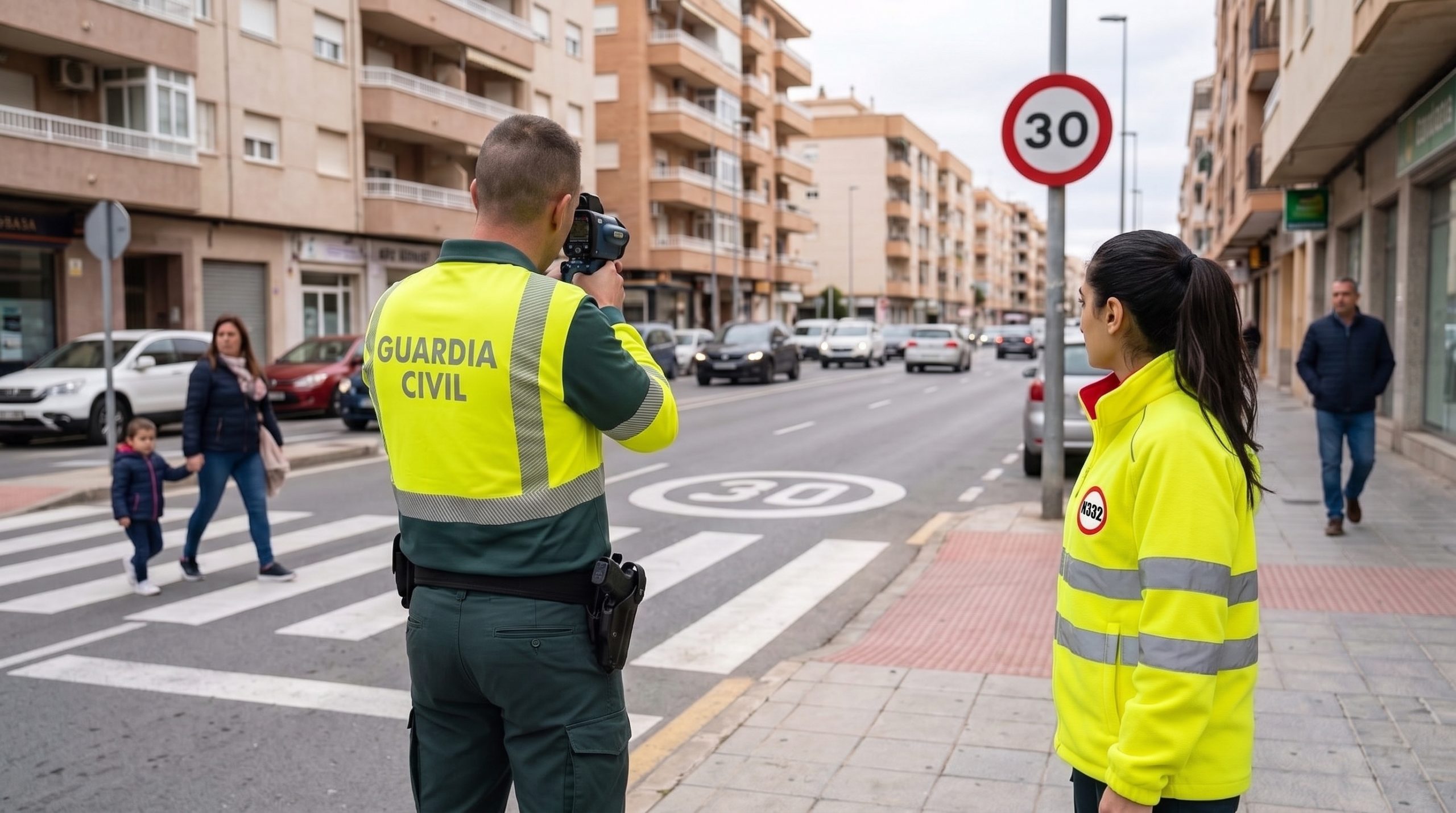

Between 16 and 22 September, traffic enforcement authorities across Europe will take part in the annual ROADPOL Safety Days. Organised by the European Roads Policing Network with backing from the European Commission, the overarching objective of this week-long initiative is anchored in Vision Zero: achieving at least one single day with zero road fatalities across the continent.
In Spain, the campaign is actively supported by the Dirección General de Tráfico (DGT), with operations coordinated on the ground by the Agrupación de Tráfico de la Guardia Civil, alongside regional forces (such as the Mossos d’Esquadra in Catalonia and the Ertzaintza in the Basque Country) and local police (Policía Local) in municipalities nationwide.
The campaign highlights the safety and legal obligations surrounding pedestrians and vulnerable road users. For British and international motorists driving on Spanish roads, understanding how Spanish traffic law prioritises pedestrians is vital to avoid severe financial penalties, licence point deductions, and, above all, catastrophic collisions.
Contents
The Enforcement Focus: Vulnerable Road Users and Pedestrians
According to pan-European collision telemetry, pedestrians continue to represent approximately 18% of all road fatalities across the European Union. Unlike vehicle occupants protected by crumple zones, airbags, and seatbelts, pedestrians bear the brunt of any kinetic impact.
During the week of 16 to 22 September, roadside checks and automated surveillance in Spain will focus on:
- Priority at Pedestrian Crossings (Pasos de Peatones): Ensuring drivers give way fully to pedestrians already on, or clearly preparing to step onto, a designated crossing.
- Speed Compliance in Urban and Residential Areas: Enforcing urban limits, specifically the standard 30 km/h baseline on single-carriageway urban streets, where survival rates for pedestrian strikes increase exponentially compared to 50 km/h impacts.
- Pavement and Crossing Obstructions: Preventing illegal parking or waiting on pavements, pedestrian ramps, and crossing sightlines, which forces pedestrians into live traffic lanes.
- Distracted Driving: Detecting mobile phone usage and infotainment screen manipulation near school zones, shopping strips, and transit hubs.
- Driver Impairment: Conducting targeted breathalyser and drug screening checks during mornings and evenings in areas with high footfall.
Spanish Traffic Law: Rights and Obligations
Spanish traffic regulations (Reglamento General de Circulación) set out explicit duties for motorists regarding pedestrian safety.
1. Failure to Give Way
Under Article 65 of the Spanish Traffic Law, failing to respect the priority of pedestrians when required is classified as a grave offence (infracción grave).
- The Penalty: A fixed fine of 200 euros and the loss of 4 points from your driving licence.
- Key Requirement: Drivers must not merely stop when a pedestrian is directly in front of the bonnet; you must anticipate and slow down when approaching a crossing if a pedestrian demonstrates a clear intention to cross. Stopping abruptly or revving the engine to rush a crossing pedestrian is also prohibited.
2. Urban Speed Limits and the 30 km/h Standard
Spain’s nationwide urban speed framework establishes strict default limits:
- 20 km/h on streets that share a single surface between vehicles and pedestrians (pedestrian-priority shared zones).
- 30 km/h on single-lane roads in each direction of travel (covering the vast majority of urban and residential streets).
- 50 km/h only on urban roads with two or more lanes per direction.
Exceeding these limits in built-up areas not only attracts progressive fines from 100 euros up to 600 euros and up to 6 penalty points, but exceeding the limit by more than 60 km/h in an urban area is classified as a criminal offence under Article 379 of the Spanish Penal Code, carrying mandatory court appearances, licence bans, and potential custodial sentences.
3. Parking on Pavements and Crossings
Stopping or parking a vehicle on a pedestrian crossing, a tactile paving strip, or a footpath is strictly prohibited. It incurs a 200 euro fine without points, and municipal towing services (grúa) will impound the vehicle at the owner’s expense.
Obligations for Pedestrians on Interurban Roads
Road safety under Spanish law is a shared responsibility. International residents and tourists walking along Spanish secondary roads or outskirts should note that pedestrian obligations are also codified and actively enforced:
- Walking on the Left: Outside built-up areas, pedestrians walking along the road or shoulder must walk on the left-hand side facing oncoming traffic, allowing them to see approaching vehicles directly. (Exceptions apply to individuals pushing a bicycle or moped, or wheelchair users, who must travel on the right).
- High-Visibility Clothing at Night: Under Article 123, any pedestrian walking on an interurban road outside daylight hours or during adverse weather conditions must wear an approved reflective vest or high-visibility garment visible from a distance of at least 150 metres. Failure to do so carries an on-the-spot 80 euro fine.
- Motorway Prohibition: Pedestrians are strictly forbidden from walking along autopistas (AP) and autovías (A). If a vehicle breaks down, occupants must never wander onto the carriageway.
Practical Driving Advice for Spain During ROADPOL Week
- Look Beyond the Kerb: In towns and coastal residential urbanisations across regions like the Costa Blanca, pedestrian crossings frequently sit immediately after roundabouts or behind parked delivery vans. Approach every pedestrian crossing with foot poised over the brake.
- School Run Vigilance: With the academic year commencing across Spain in early September, school perimeters experience sudden spikes in child pedestrian activity between 08:30–09:15 and 13:30–15:00. Exercise extreme caution and strictly observe advisory 20 km/h or 30 km/h limits.
- Observe Overtaking Prohibitions at Crossings: Under Article 73, overtaking another vehicle that has stopped or slowed down before a pedestrian crossing is strictly forbidden unless the movement can be carried out at such a low speed that the driver can stop instantly if a pedestrian suddenly appears.
- Expect Increased Checkpoints: Anticipate both marked and unmarked Guardia Civil patrols on regional corridors (such as the N-332 and surrounding CV connector routes), as well as dedicated speed van deployments by local police in urban centres.
Discover more from N332.es - Driving In Spain
Subscribe to get the latest posts sent to your email.