
There is a fundamental difference between overtaking another car and overtaking a cyclist.
The other vehicle has a substantial metal structure around its occupants.
The cyclist has a bicycle.
That difference should influence every decision a driver makes.
A cyclist can be destabilised by something that would barely affect a car.
A sudden gust of wind.
A pothole.
A drain cover.
A piece of debris.
A vehicle passing too closely in the opposite direction.
A momentary movement of the bicycle.
The cyclist does not have the protection of a passenger compartment if something goes wrong.
The driver does.
The 1.5-metre rule remains fundamental
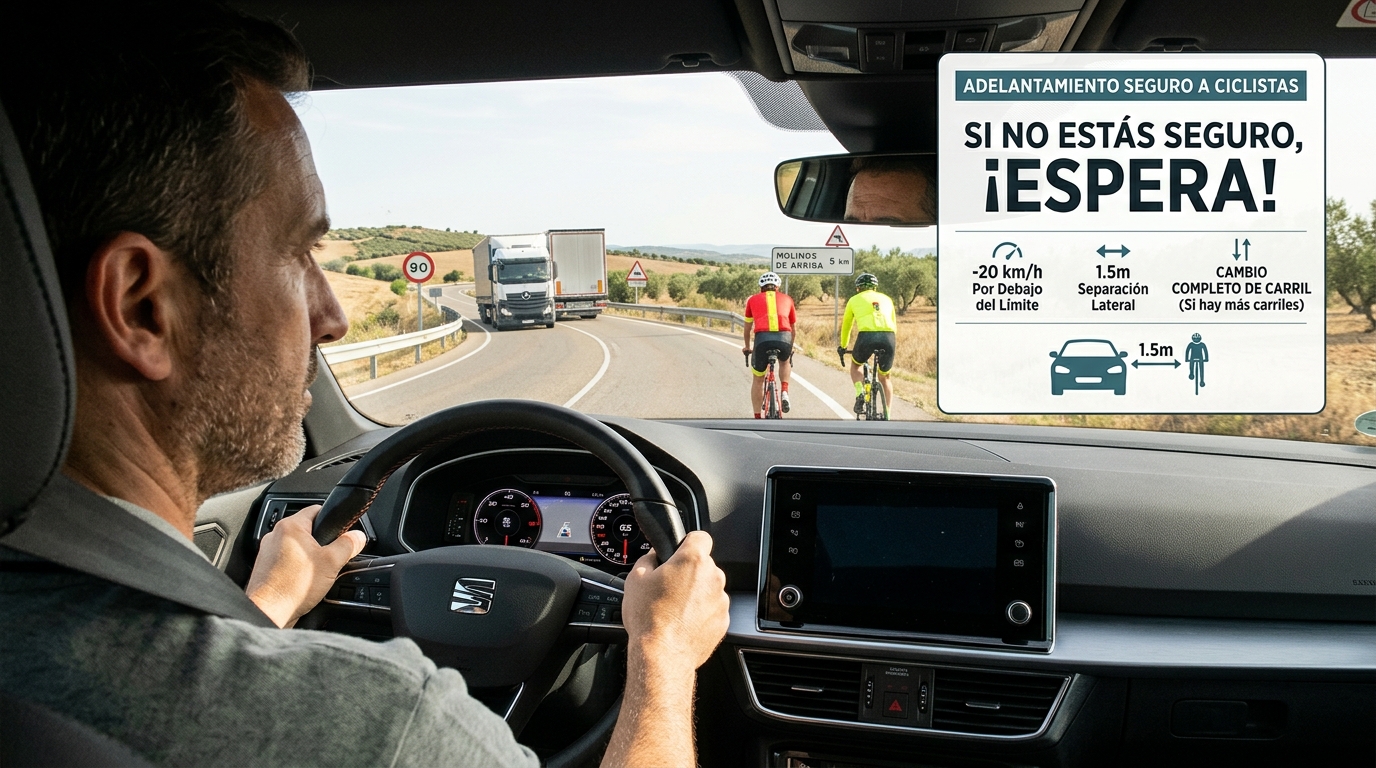
Spanish law requires a driver overtaking a cyclist to leave a minimum lateral separation of 1.5 metres.
That is not a suggestion.
It is the minimum safety margin.
But even 1.5 metres should not be treated as a target to hit mechanically.
If conditions mean that 1.5 metres cannot be achieved safely, the correct decision is simple.
Do not overtake.
Wait.
More than one lane means a complete lane change
The new rules reinforce this principle.
Where a road has more than one lane in the same direction, the driver overtaking a cyclist must make a complete change of lane, rather than remaining partially alongside the cyclist.
This creates a much larger physical buffer between the vehicle and the bicycle.
It is a significant change in how drivers should think about the manoeuvre.
The question is no longer:
“Can I squeeze past?”
It is:
“Can I move completely away from the cyclist?”
If the answer is no, wait.
Speed matters too
From 1 October 2026, when overtaking a cyclist outside built-up areas, the driver must reduce speed by at least 20 km/h below the applicable speed limit throughout the manoeuvre.
This is an important change in thinking.
Previously, drivers might have regarded speed as something that helped them complete the manoeuvre quickly.
The new approach recognises that the vulnerable road user needs protection from the speed difference as well as the physical proximity of the vehicle.
Slowing down gives everyone more time.
Think about what the cyclist cannot control
Imagine riding a bicycle along an exposed road.
You are concentrating on maintaining your line.
Then a large vehicle approaches.
Even if the driver intends no harm, the movement and air pressure around the vehicle can affect the bicycle.
A sudden gust can destabilise a cyclist.
A nervous reaction can cause them to move sideways.
The driver may have done nothing deliberately wrong.
But the cyclist has still been placed in a dangerous situation.
That is why space matters.
The safest overtake may be no overtake
This is perhaps the most important message.
You do not have to overtake simply because you have caught up with a cyclist.
If the road is narrow, traffic is approaching, visibility is limited or there is insufficient room to create the required separation, remain behind.
The cyclist is not an obstacle that needs to be cleared as quickly as possible.
They are another person using the road.
Wait for a safe opportunity.
Do not be influenced by the driver behind
This is particularly important when traffic builds behind you.
A driver may be impatient.
They may move closer.
They may appear to expect you to pass.
That pressure is irrelevant.
You are responsible for your own manoeuvre.
If the conditions are not safe, do not allow another driver’s impatience to make the decision for you.
Remember the imbalance
A cyclist and a car may both be legally entitled to use the road.
But they are not equally protected.
The car driver has a seat, airbags, a roof and a structure designed to absorb impact.
The cyclist has none of those things.
That does not make cyclists infallible.
It does mean that the consequences of a mistake are very different.
The DGT itself describes cyclists as one of the most vulnerable groups of road users and advises drivers to reduce speed and give them the necessary time and space.
Safe overtaking is a decision, not a reflex
See the cyclist.
Assess the road.
Check the traffic.
Look at the available space.
Reduce speed.
Move completely into the adjacent lane where required.
Leave at least 1.5 metres.
And if any of those conditions cannot be achieved safely, remain behind.
There is nothing wrong with waiting.
In fact, sometimes the most responsible overtaking manoeuvre is the one you decide not to make.
Because arriving a few seconds later matters very little.
Making sure the person on the bicycle arrives safely matters enormously.
Discover more from N332.es - Driving In Spain
Subscribe to get the latest posts sent to your email.