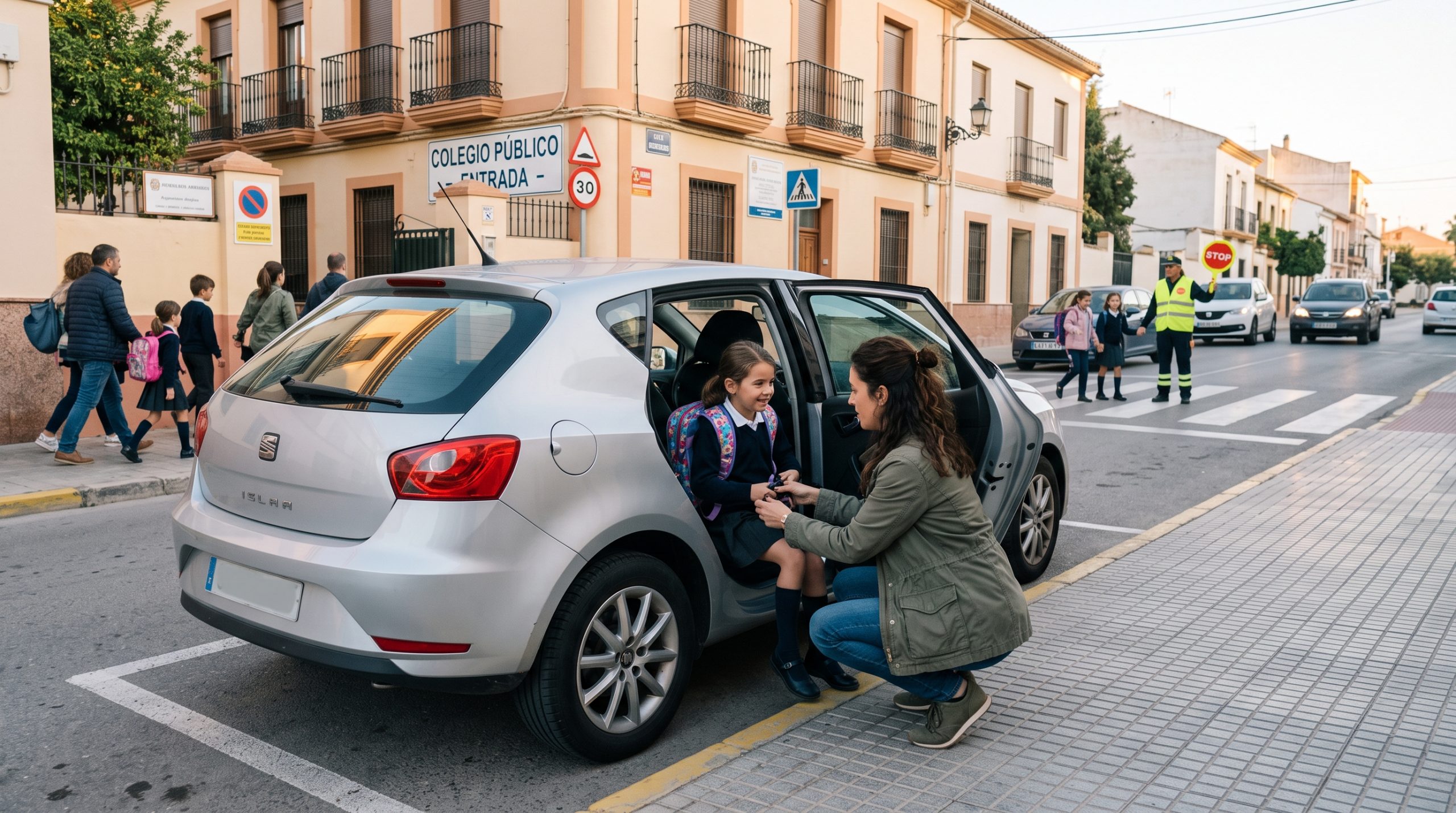

The school run is back.
For many parents, that means the return of early mornings, packed lunches, school bags and the familiar journey to and from the school gates.
It is also a return to one of the most important road-safety responsibilities a parent has.
Not simply getting a child to school.
Teaching them how to travel safely.
Children learn enormously from watching adults.
They notice what we do.
They notice how we speak to other drivers.
They notice whether we rush.
They notice whether we stop where we should.
And they notice whether we buckle our own seat belt.
The school run is therefore about much more than getting from A to B.
Start with the child’s restraint
Before the car moves, the child needs to be properly secured.
In Spain, children of 135 centimetres or less must use an appropriate, approved child restraint system adapted to their height and weight. As a general rule, children should travel in the rear seats, subject to the specific legal exceptions.
This is not something to negotiate because the journey is short.
In fact, short journeys deserve exactly the same attention as long ones.
The school may be only five minutes away.
That does not make a collision any less serious.
The DGT’s latest child-restraint campaign continues to highlight incorrect or absent use of child restraint systems as an important safety problem.
Secure them before you start
A child should not be climbing into a moving car and fastening themselves while the vehicle is already underway.
Take the time to check that the restraint is correctly installed and that the child is properly secured before setting off.
It is also worth remembering that the system needs to be appropriate for the child’s current size.
Children grow quickly.
A restraint that fitted perfectly last year may no longer be appropriate now.
Where you stop matters
The school gate can become chaotic very quickly.
Parents arrive at similar times.
Children are getting out.
Other vehicles are moving around them.
Pedestrians are crossing.
That is why parents should use designated, authorised or otherwise safe stopping locations, rather than creating an improvised drop-off point simply because it is closer to the entrance.
A few extra metres of walking are a very small price to pay for a safer arrival.
Never allow convenience to turn the pavement, crossing or road edge into an improvised loading area.
Put the child on the safer side
Whenever the situation and vehicle layout allow, think carefully about which side the child will use to leave the car.
The aim should be to have the child exit towards the pavement or another protected area, rather than stepping directly into moving traffic.
This is particularly important with younger children, who may not fully understand the danger presented by a vehicle approaching from behind.
The adult should control the situation rather than expecting the child to do so.
Don’t rush the school gate
The school run can be stressful.
There may be traffic behind you.
You may be running late.
Another parent may be waiting.
But children learn from how adults respond to pressure.
If a driver behaves aggressively because somebody is taking too long, children notice.
If a parent parks somewhere unsafe because they are in a hurry, children notice that too.
If an adult waits patiently, follows the rules and treats other people with courtesy, children notice that as well.
Road safety is learned long before a child eventually sits behind a steering wheel.
Your child is watching
Parents naturally teach children to look both ways before crossing.
But children learn another set of lessons simply by observing.
They see whether adults wear their seat belts.
They see whether drivers stop properly.
They see whether people use pedestrian crossings.
They hear how adults talk about other drivers.
They observe whether patience disappears when traffic becomes difficult.
These behaviours become normal to them.
The example we set today can influence the road user they become years from now.
The school run is also a lesson in patience
There will be queues.
There will be drivers who hesitate.
There will be people who stop where they should not.
There will be children who take longer to cross.
The answer is not to make the journey a competition.
A few minutes of delay is insignificant compared with the safety of a child.
Parents can help create a calmer environment simply by accepting that the school run takes time.
Walking the last few metres can be a good thing
It is tempting to think that the best drop-off point is the one closest to the school entrance.
It often isn’t.
A safe location a short distance away may allow the child to walk the final part of the journey away from the worst congestion.
That can be better for everyone.
It also gives parents an opportunity to practise road awareness with their children.
Look.
Listen.
Wait.
Cross safely.
Those simple lessons accumulate.
The journey does not end when the car stops
Getting to school safely is only half of the task.
The way we get there matters too.
Secure the child correctly.
Choose a safe place to stop.
Keep them away from moving traffic.
Remain patient.
And show them, every day, what responsible road behaviour looks like.
Because children do not learn about road safety only from lessons and signs.
They learn from us.
And the school run gives parents one of the best opportunities they will ever have to teach it.
Discover more from N332.es - Driving In Spain
Subscribe to get the latest posts sent to your email.