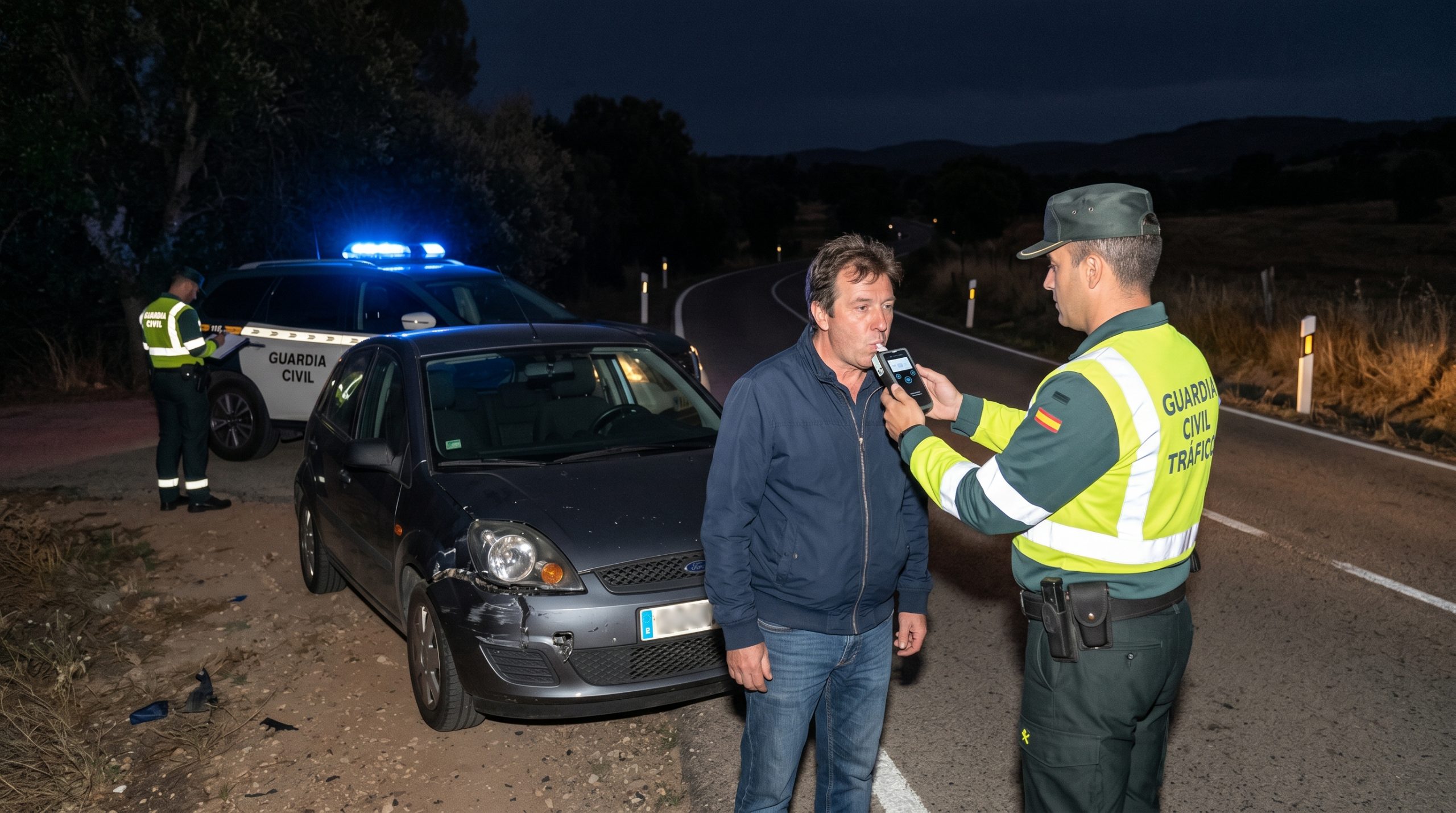
If you are driving anywhere in Spain over the next few days, you need to be prepared for an unprecedented level of traffic surveillance. This week, Spain’s Dirección General de Tráfico (DGT) and the Agrupación de Tráfico de la Guardia Civil are participating in a major pan-European road safety initiative: ROADPOL Operation Alcohol & Drugs.
The absolute peak of this operation will take place this Friday, during a continuous, 24-hour testing marathon.
During this window, standard random sampling is being replaced by massive, multi-lane checkpoint funnels. These checkpoints will be heavily deployed across secondary single-carriageway routes and major access roads leading to coastal leisure hubs, including heavy grids surrounding Torrevieja, Alicante, and Benidorm.
However, this marathon is not merely about issuing fines or deducting points. It is a direct confrontation with a complex safety crisis that requires every motorist to understand two distinct forms of impairment—and a critical moral responsibility we all share.
Contents
The Dual Threat: Deceptive Highs vs. Muted Reflexes
The human cost of driving under the influence remains staggering, with chemical impairment playing a role in over a third of all fatal highway collisions in Spain. This campaign focuses equally on two distinct pillars of impairment, both of which distort human capability in completely different ways.
Alcohol: The Central Nervous System Drag
Alcohol is a classic depressant. It systematically slows brain activity and dulls physical reaction times. At Spain’s legal limit, your reaction time is already delayed by roughly a third of a second. At highway speeds of 120 km/h, that tiny cognitive lag means your vehicle travels an additional 11 metres before your foot can even touch the brake pedal. This being in otherwise optimum conditions without other distractions.
Worse still, alcohol targets the brain’s frontal lobe, eroding risk aversion. Drivers under the influence often know they are delayed, but their internal danger radar has been muted, causing them to take reckless risks they would normally avoid.
Narcotics: The Delusion of Focus
On the other side of the matrix is drug-driving. While alcohol produces an obvious, linear degradation of coordination, psychoactive substances completely rewire how the mind processes real-time data. Cannabis (THC) profoundly distorts time, space, and peripheral orientation, leaving drivers struggling to track lane boundaries. Conversely, synthetic stimulants like cocaine trigger a state of illusory superiority. Because the drug floods the brain with dopamine, the driver feels hyper-alert and entirely awake.
This is the deadly delusion: the driver genuinely believes they are operating at peak performance, completely blind to the fact that their peripheral vision has narrowed into a tight tunnel, their micro-spatial processing is broken, and their ability to react to a sudden hazard is severely compromised.
The Catastrophic Combination
The danger spikes exponentially when these two forces meet. Poly-substance use—combining alcohol with illicit or prescription drugs—is a rapidly rising trend in weekend accident data.
When a depressant meets a stimulant, they don’t simply add their risks together; they multiply them. Statistical metrics tracked by the European Transport Safety Council (ETSC) demonstrate that while driving under the influence of a single substance increases collision probability linearly, mixing alcohol and drugs triggers an exponential risk curve, making a fatal crash up to thirty times more likely than driving completely sober. The chemical combination scrambles the brain’s feedback loops: the stimulant masks the drowsiness of the alcohol, making the driver feel entirely capable, while the alcohol simultaneously dissolves the baseline caution of the drug.
Warning 1: The Only Safe Limit is Zero
This complex chemical reality is exactly why we must completely discard the dangerous game of “calculating” your limits. Trying to guess whether you are under the legal limit based on your weight, what you ate, or how many hours have passed is a game of Russian roulette.
When it comes to safeguarding human life, the only safe limit is zero.
If you are operating a motor vehicle, you must be entirely free from the influence of any mind-altering substance. If you plan to consume alcohol or are taking prescription medication that flags a driving warning, the key to safe transit is absolute: pre-arrange a taxi, utilize public transport, or assign a dedicated sober driver. There is no middle ground.
Warning 2: Do Not “Tip Off” Other Drivers
There is a widespread, cultural habit within the motoring community—both online via social media groups and on the tarmac through the flashing of headlights—of warning oncoming traffic about police checkpoints.
We need to be absolutely blunt about this: stop doing it.
Flashing your lights or dropping a pin on an app to alert others to a Guardia Civil checkpoint is not an act of community solidarity. It is an act of profound irresponsibility that could cost an innocent life.
When you warn an impaired driver to alter their route and avoid a checkpoint, you are not saving them from a €1,000 fine. You are actively helping a dangerous, chemically compromised individual bypass the only safety net capable of removing them from the road.
The driver you “saved” from a breathalyzer five minutes ago could be the exact same driver who crosses a solid white line a few kilometres down the road and hits a vehicle carrying an innocent family. Checkpoints are the literal difference between life and death. Let the police do their job, protect your community, and keep the location of safety grids to yourself.
Discover more from N332.es - Driving In Spain
Subscribe to get the latest posts sent to your email.