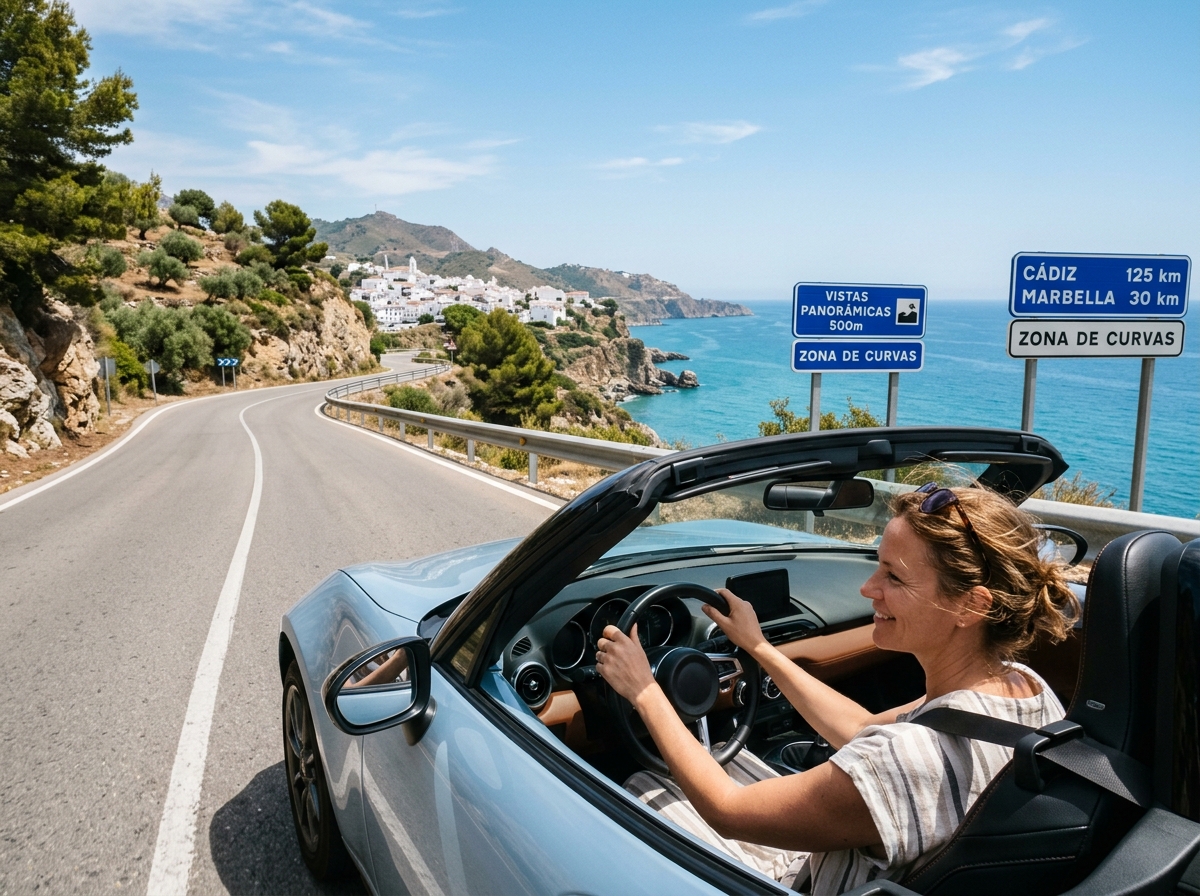

Most people think of holidays as a time to slow down.
We escape our daily routines, spend more time outdoors, enjoy longer evenings and try to leave the pressures of work behind. It is exactly what a holiday should be.
Ironically, however, that relaxed state of mind can sometimes lead us to make decisions we would never normally make at home.
Not because we become reckless.
Because we become comfortable.
Road safety experts have long understood that human behaviour changes depending on the environment. Holiday driving is a perfect example.
Contents
We Stop Thinking About Risk
Think about your normal weekday routine.
You probably leave home at roughly the same time.
Drive familiar roads.
Know where the busy junctions are.
Recognise the speed limits.
Anticipate where traffic builds up.
Without realising it, your brain has developed a detailed mental map of those journeys.
Now compare that with driving on holiday.
Different roads.
Different traffic.
Different weather.
Different vehicle.
Different passengers.
Different routines.
The brain suddenly has much more information to process.
Yet at exactly the same time, we are trying to relax.
The Holiday Mindset
Psychologists often talk about something called risk compensation.
It describes our tendency to adjust behaviour according to how safe or relaxed we feel.
When people feel comfortable, they often become slightly less cautious.
Not dramatically.
Just enough to matter.
Perhaps we drive for another hour before stopping.
Perhaps we postpone checking the tyres.
Perhaps we assume the satnav will take care of everything.
Perhaps we become distracted by the scenery.
None of these decisions appears particularly dangerous on its own.
Together, they gradually reduce our safety margins.
“It’ll Be Fine”
One of the most common phrases heard during holidays is also one of the most revealing.
“It’ll be fine.”
We’ll stop at the next service station.
We’ll fill up later.
We’ll eat when we arrive.
We’ll have a proper rest tomorrow.
We’ll check the warning light after the weekend.
Sometimes it really is fine.
Sometimes it isn’t.
The difficulty is that human beings are remarkably good at convincing themselves that today’s situation will turn out exactly like yesterday’s.
Familiar Success Creates Confidence
Imagine somebody has driven to the Costa Blanca every summer for the past ten years.
Nothing serious has ever happened.
Each successful journey quietly reinforces a belief.
“I know this route.”
“I’ve done this loads of times.”
“I’m an experienced driver.”
All of those statements may be true.
Yet they can also encourage complacency.
Experience is valuable.
Overconfidence is something very different.
We Notice Less Than We Think
One of the fascinating discoveries in psychology is that people often overestimate how much attention they are paying.
Our brains constantly filter information.
This helps us avoid becoming overwhelmed.
Unfortunately, it also means we sometimes fail to notice important changes around us.
A cyclist emerging from a side road.
A pedestrian stepping into the carriageway.
A queue developing around the next bend.
The information was there.
Our attention simply wasn’t.
Holidays Bring New Distractions
Holiday driving includes distractions that rarely exist during ordinary journeys.
Children asking questions.
Passengers pointing out landmarks.
Looking for hotel entrances.
Searching for restaurants.
Watching the coastline.
Trying to understand unfamiliar road signs.
Every one of these demands a little attention.
Individually, they seem harmless.
Collectively, they increase mental workload.
The Value of Small Pauses
Perhaps the simplest way to reset attention is also one of the easiest.
Stop.
Walk around.
Drink some water.
Take a few deep breaths.
Stretch your legs.
These small pauses interrupt the gradual decline in concentration that often develops during long journeys.
They also remind us that arriving safely is more important than arriving quickly.
The Best Drivers Continue Learning
One characteristic appears consistently among highly experienced drivers.
They never assume experience makes them immune from mistakes.
Instead, they remain curious.
They question their own decisions.
They continue checking mirrors carefully.
They continue planning ahead.
They continue respecting the road.
That mindset often proves far more valuable than years of driving experience alone.
Holidays Should Leave Happy Memories
Road safety is sometimes portrayed as following rules.
In reality, it is often about understanding ourselves.
Recognising when we are becoming tired.
Recognising when we are rushing.
Recognising when familiarity has quietly become complacency.
The more we understand our own behaviour, the easier it becomes to make better decisions.
Because the greatest risk on many summer journeys is not the weather.
Or the traffic.
Or even the road itself.
It is the quiet belief that nothing is likely to go wrong.
Fortunately, awareness is one of the simplest ways to challenge that belief.
And sometimes, simply recognising our own human nature is enough to make the journey home a safer one.
Discover more from N332.es - Driving In Spain
Subscribe to get the latest posts sent to your email.