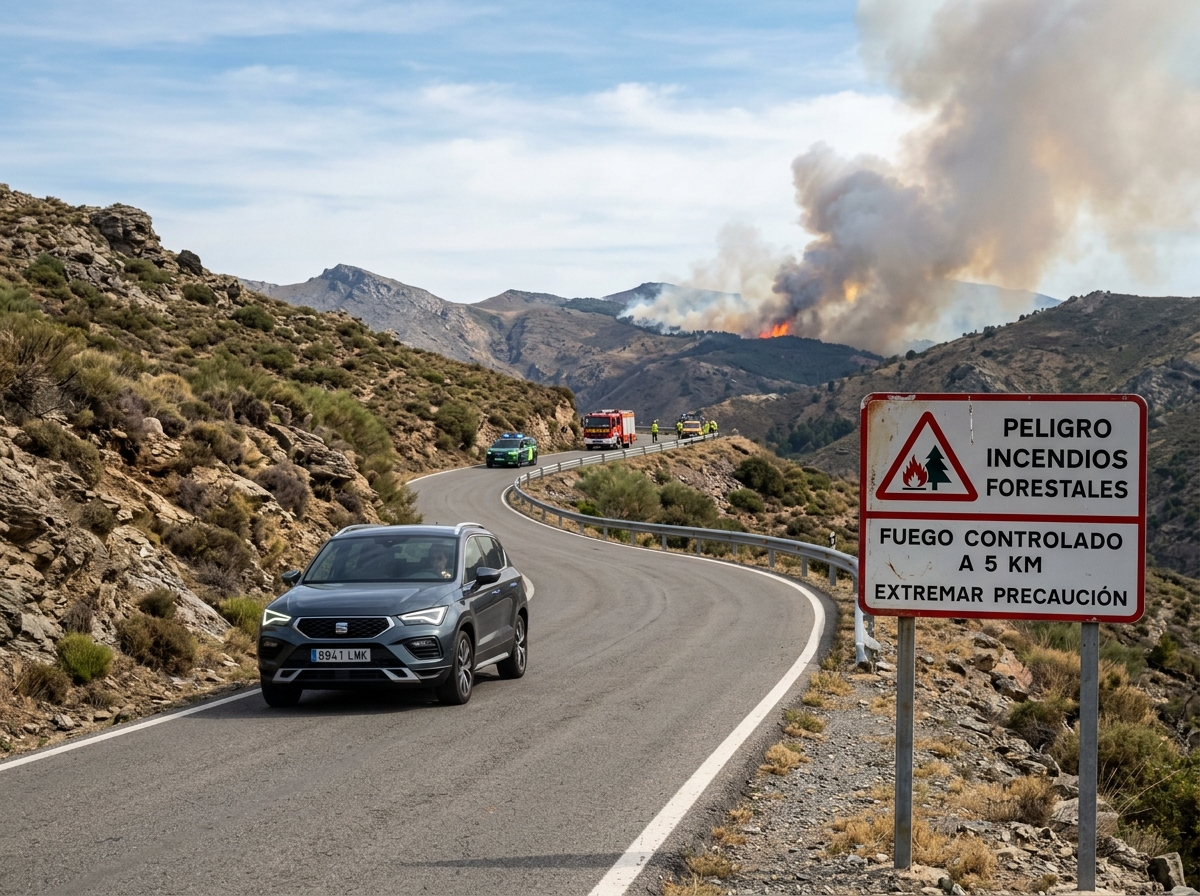

For many people, wildfires are something they associate with television news or dramatic images from distant places. Yet across Spain, particularly during the hottest months of the year, wildfires are a very real hazard that can affect roads with little warning.
Fortunately, most drivers will never find themselves anywhere near a wildfire.
However, if you regularly travel through rural areas, mountain roads or forests during the summer, understanding how to react calmly and safely could make all the difference.
Contents
Wildfires Can Move Surprisingly Quickly
Unlike many other road hazards, wildfires are constantly changing.
Wind direction.
Terrain.
Vegetation.
Temperature.
Humidity.
All influence how rapidly a fire spreads.
A road that appears perfectly safe one moment may become affected by smoke or flames a short time later.
This is why authorities sometimes close roads with very little notice.
Their objective is always to prevent drivers becoming trapped.
Smoke Is Often the First Danger
Many people naturally focus on the flames.
In reality, smoke is frequently the greater immediate hazard.
Dense smoke dramatically reduces visibility, making it difficult to judge bends, approaching traffic or obstacles ahead.
It can also affect breathing and reduce concentration, particularly during prolonged exposure.
If you encounter smoke while driving, reduce your speed immediately, increase the distance between your vehicle and the one ahead, and switch on dipped headlights to improve your visibility to other road users.
Avoid using full beam, as it reflects from smoke particles and can reduce visibility even further.
Never Drive Towards Flames
Curiosity can be surprisingly dangerous.
If emergency services have closed a road or advised drivers to turn around, do so immediately.
Attempting to continue because the fire “doesn’t look too bad” places both you and emergency responders at unnecessary risk.
Wildfires rarely behave predictably.
A change in wind direction can transform a manageable situation into a dangerous one within minutes.
If Escape Is Still Possible
If you notice smoke or fire ahead while there is still a safe opportunity to change direction, do so calmly.
Do not perform sudden U-turns or emergency manoeuvres.
Turn around only where it is safe and legal, and follow any directions given by emergency services or the Guardia Civil.
If diversion routes are available, use them.
A longer journey is always preferable to entering an unsafe area.
If You Become Trapped
Although rare, there are occasions when drivers find themselves unable to leave the affected area immediately.
If this happens, remain calm.
Panic leads to poor decisions.
Close all windows and switch the ventilation system to recirculation to reduce the amount of smoke entering the passenger compartment.
If possible, move towards an open area away from trees, bushes and dense vegetation.
Car parks, wide clearings and cultivated land generally present lower fire risks than wooded areas.
Your Vehicle Offers Some Protection
Instinct may tell you to leave the vehicle immediately.
However, unless emergency services instruct otherwise or there is a clearly safe escape route, your vehicle often provides more protection than attempting to run through dense smoke or burning vegetation.
The metal body of the vehicle offers temporary protection from radiant heat, while remaining inside also makes it easier for emergency services to locate you if necessary.
Call 112 If Necessary
If you become trapped or witness a wildfire threatening road users, call 112 as soon as it is safe to do so.
Provide as much information as possible.
Road number.
Kilometre marker.
Nearby junction.
GPS location if available.
Clear information helps emergency services respond more quickly and direct resources where they are needed most.
Prepare Before Travelling
During periods of extreme fire risk, particularly when travelling through inland Spain, it is worth checking weather forecasts and traffic information before setting off.
A fully charged mobile phone, drinking water and a basic emergency kit are sensible additions for longer journeys through rural areas.
These items are useful not only during wildfires but for any unexpected delay.
Prevention Begins with Drivers Too
Drivers also play a role in preventing fires.
Never throw cigarette ends from vehicle windows.
Avoid parking on dry grass where hot exhaust systems or catalytic converters may ignite vegetation.
Dispose of litter responsibly, particularly glass bottles which can contribute to fires under certain conditions.
Small actions make a significant difference during periods of extreme heat.
Respect the Conditions
Most journeys through Spain’s countryside are peaceful and uneventful.
Wildfires remain relatively uncommon compared with the millions of safe journeys made every summer.
The objective is not to create fear.
It is to promote awareness.
Knowing how to respond calmly, respecting road closures and understanding that smoke often presents the greatest immediate danger allows drivers to make sensible decisions should the unexpected occur.
Because the safest response to a wildfire is rarely the fastest one.
It is the calmest one.
Discover more from N332.es - Driving In Spain
Subscribe to get the latest posts sent to your email.