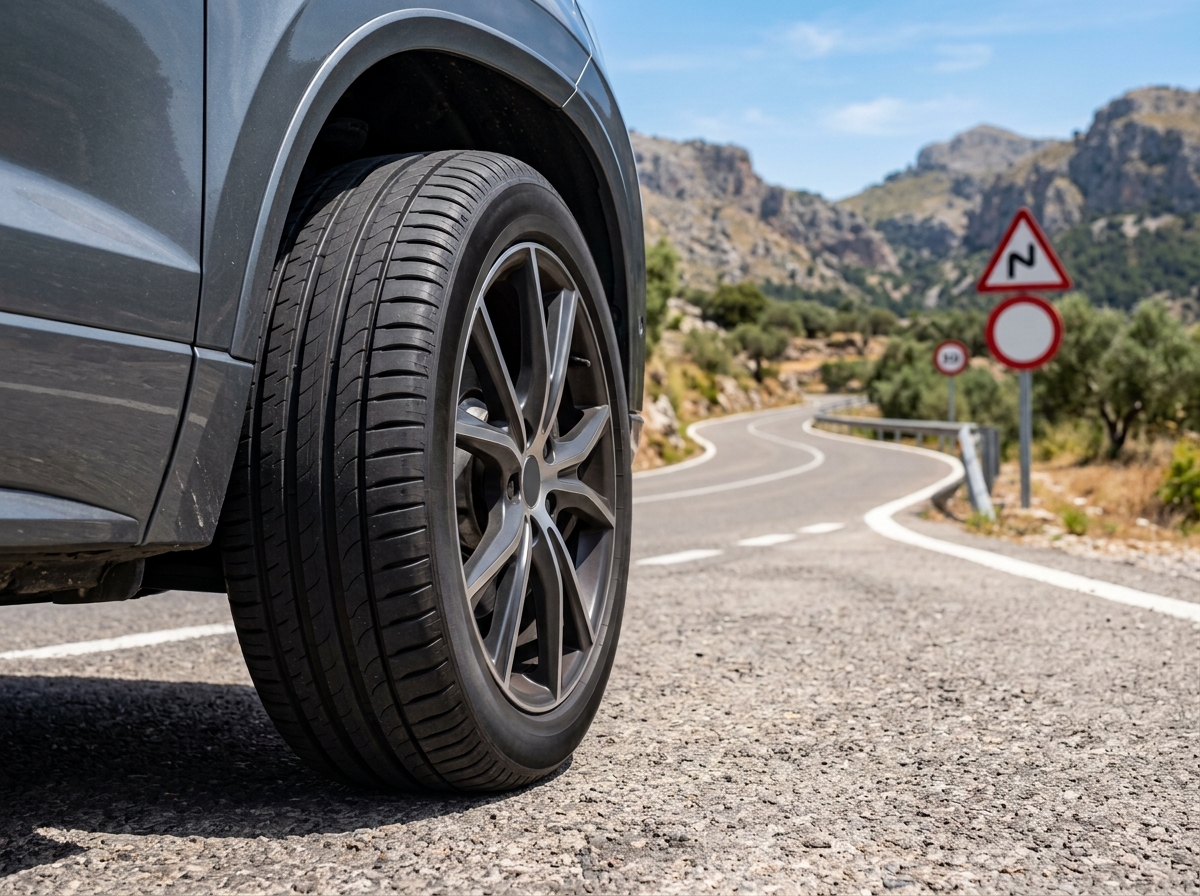

If someone asked you to name the most important safety feature on your car, what would you choose?
Modern vehicles are equipped with an impressive range of technology. Anti-lock braking systems, electronic stability control, airbags, lane assistance and emergency braking all play an important role in keeping drivers safe.
Yet every one of those systems relies on just four small contact patches, each little larger than the palm of your hand.
Your tyres.
They are the only part of your vehicle touching the road, making them arguably the most important safety feature your car possesses.
Contents
Summer Places Greater Demands on Tyres
Spain’s summer climate creates ideal conditions for driving, but it also increases the demands placed on your tyres.
Road surfaces become considerably hotter than the surrounding air. Add long motorway journeys, heavy holiday luggage and sustained high speeds, and your tyres are working much harder than during an ordinary journey around town.
Heat increases tyre pressure naturally as the air inside expands. It also accelerates wear and can expose weaknesses that might have gone unnoticed during cooler months.
This is why tyre checks should form part of every summer travel routine.
Pressure Matters More Than You Think
One of the simplest vehicle checks is also one of the most frequently ignored.
Driving with incorrect tyre pressures affects almost every aspect of vehicle performance.
Under-inflated tyres flex more as they rotate, generating additional heat and increasing rolling resistance. This leads to higher fuel consumption, faster wear and a greater risk of tyre failure during long journeys.
Over-inflated tyres create a different problem. Because less rubber remains in contact with the road, grip is reduced, braking distances may increase and the centre of the tread tends to wear more quickly.
Neither situation is ideal.
Always check tyre pressures when the tyres are cold and before beginning a journey. If your vehicle is carrying additional passengers or luggage, remember that many manufacturers recommend higher pressures for heavier loads. The correct figures can usually be found inside the driver’s door frame, fuel filler flap or owner’s handbook.
Tread Is About More Than the Law
The legal minimum tread depth for cars in Spain is 1.6 mm.
However, waiting until a tyre reaches the legal minimum is rarely the safest approach.
As tread depth reduces, so does the tyre’s ability to disperse water, maintain grip and respond effectively during emergency manoeuvres. Although summer is generally dry, sudden heavy storms can leave standing water on roads within minutes.
Replacing tyres before they become excessively worn provides an additional margin of safety, particularly if you regularly travel long distances.
Wear Can Tell a Story
Tyres do much more than carry your vehicle.
They also reveal its condition.
Uneven wear may indicate incorrect wheel alignment.
Excessive wear on one edge could suggest suspension problems.
Rapid wear across the centre may point towards over-inflation.
Shoulders wearing faster than the centre often indicate low pressure.
In many ways, tyres act as the vehicle’s health monitor.
A quick visual inspection before travelling may identify problems long before they become expensive repairs.
Choosing the Right Replacement
Eventually every tyre reaches the end of its useful life.
When that time comes, price should not be the only consideration.
Premium tyres often provide shorter stopping distances, improved wet weather performance, lower rolling resistance and reduced noise levels. They also tend to maintain those characteristics for longer as the tyre wears.
That does not mean every driver needs the most expensive option available.
Instead, choose tyres that suit your vehicle, your driving style and the conditions in which you normally travel. A family car used primarily for motorway journeys has different requirements from a compact urban vehicle or an electric car, where weight and torque place additional demands on the tyres.
Understanding the European Tyre Label
Every new tyre sold in Europe carries a standard information label.
Although many drivers overlook it, the label provides valuable information about three important characteristics:
- Fuel efficiency.
- Wet grip.
- External rolling noise.
These simple ratings make it easier to compare different products objectively rather than relying solely on price or brand recognition.
Don’t Forget the Spare
Many newer vehicles no longer carry a conventional spare wheel, relying instead on repair kits or run-flat technology.
Whatever your vehicle uses, check that it is complete and ready before travelling.
If you have a spare wheel, ensure it is properly inflated.
If you carry a repair kit, check that the sealant has not passed its expiry date.
Neither is particularly useful if discovered only after a puncture has occurred.
Four Small Contact Patches
When travelling at motorway speeds, it is easy to forget that every steering input, every braking manoeuvre and every corner depends on four areas of rubber no larger than four postcards placed on the road.
Those four contact patches determine how effectively your vehicle accelerates, stops and changes direction.
Everything else simply supports them.
The Best Investment You Can Make
Many drivers spend time cleaning their cars before a holiday.
Others carefully plan routes, book accommodation and prepare luggage.
All of those things matter.
But few investments improve safety more than properly maintained tyres.
Checking pressures takes only a few minutes.
Inspecting for damage takes even less.
Yet those simple checks could make the difference between a relaxing summer journey and an unexpected interruption on the hard shoulder.
This summer, before turning the key and setting off, take one final look at your tyres.
Because every journey, no matter how long, begins with four small patches of rubber meeting the road.
Discover more from N332.es - Driving In Spain
Subscribe to get the latest posts sent to your email.