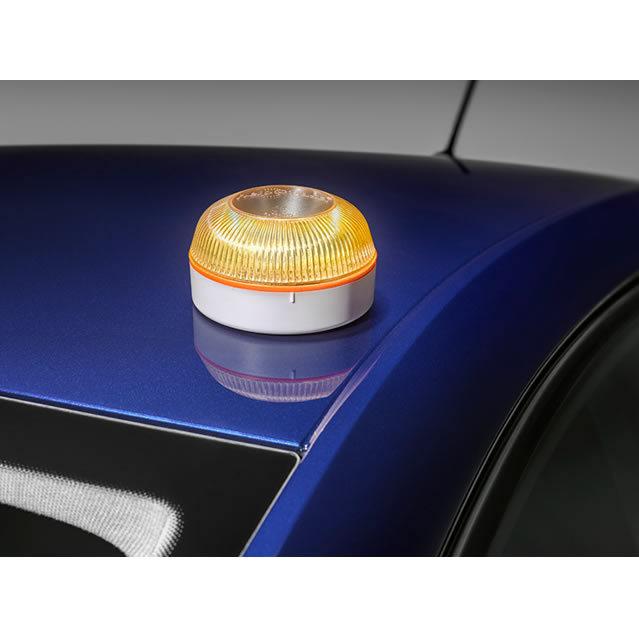

Spain’s Director-General of Traffic, Pere Navarro, has firmly defended the introduction of the V-16 emergency beacon, insisting that the device is now a permanent part of Spain’s road safety strategy.
Speaking before the Road Safety Committee in the Spanish Congress, Navarro described the beacon as a major improvement over the traditional warning triangle system that it replaced at the beginning of 2026.
Since 1st January, the connected V-16 warning light has become mandatory for cars, vans, lorries, buses and vehicle combinations registered in Spain. The system was introduced with the aim of improving visibility and reducing the dangers faced by motorists during breakdowns or incidents on the road.
Navarro argued that the biggest safety advantage is that drivers no longer need to leave their vehicles to warn approaching traffic. Instead of walking onto the carriageway to place reflective triangles, motorists can activate the beacon from inside the vehicle and place it safely on the roof.
According to the DGT chief, this change is particularly important for vulnerable road users, older drivers and people with mobility issues. During the session, Navarro referred to a letter received from a disabled driver who explained that they had previously been physically unable to exit the vehicle and position warning triangles safely.
The V-16 device also introduces a connected element to roadside emergencies. Approved beacons transmit location information to the DGT 3.0 traffic platform, helping traffic authorities identify incidents more quickly and warn other road users of hazards ahead.
However, the rollout has not been free from controversy. Questions were raised during the committee hearing regarding connectivity coverage in certain municipalities and on some local roads. Critics argued that the system may not function equally well in all areas, particularly where mobile signal coverage is weak (the V-16 uses a different network to normal mobile phone systems).
The majority of the controversy was amplified by social media, despite it stemming from myth and speculation, rather than fact, and always ignoring the point that the device was introduced to save lives.
Navarro rejected some of the criticism surrounding connectivity concerns and strongly defended the policy. He also criticised political opposition to the measure after complaints about the system were reportedly taken to European authorities. According to Navarro, European institutions ultimately backed Spain’s approach to improving roadside safety.
If you have fallen victim to the myths, and decided not to buy one based on the fake belief that the system would be removed, you need to remember that the V-16 is a mandatory piece of equipment, and must be carried in the vehicle, and not having one not only leaves you vulnerable, it renders you liable to a fine.
The congressional hearing also focused on wider transport and licensing issues, including the ongoing shortage of driving examiners across Spain.
The driving school sector has repeatedly warned that long waiting times for practical driving tests continue to affect learners in many provinces. Although the DGT has increased examiner numbers in recent years, industry representatives maintain that demand still exceeds capacity.
Current figures presented during the session indicated that Spain now has just over 1,000 driving examiners, with additional recruits expected later this year following training. Further positions are also planned within the 2026 public employment programme.
Navarro defended the workload pressures faced by the system, pointing out that around 750,000 new drivers enter Spanish roads every year. This results in more than a million theory tests and practical driving exams annually.
He compared the situation to other public services, arguing that there will always be pressure for more professionals in essential sectors such as policing, healthcare, education and road safety administration.
Discover more from N332.es - Driving In Spain
Subscribe to get the latest posts sent to your email.