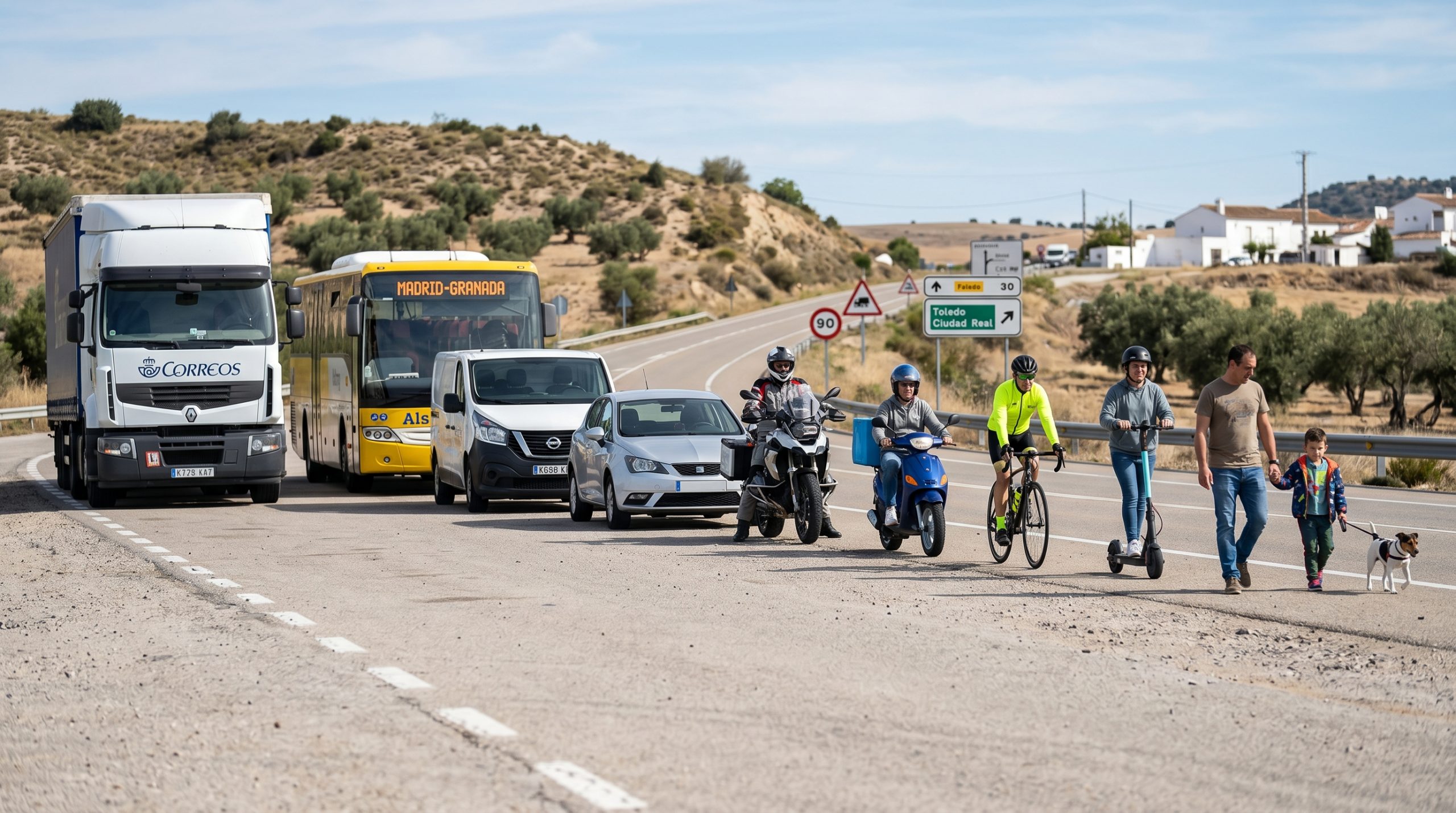

When people think about danger on the road, they often think in simple terms. Bigger vehicles are seen as stronger, smaller vehicles as weaker. But modern roads are far more complex than that, and understanding vulnerability is one of the most important parts of improving safety for everyone.
A fully loaded lorry can weigh tens of thousands of kilos and clearly has the potential to cause enormous damage in a collision. Yet that same vehicle is also far harder to stop, has significant blind spots, and requires far more space to manoeuvre safely. A cyclist or pedestrian, meanwhile, has almost no physical protection at all, but can move quickly and unpredictably through traffic. A child walking near a crossing may not yet have the ability to properly judge speed or distance. An older person may react more slowly or struggle with reduced hearing or vision.
Motorcyclists occupy a particularly vulnerable position within this spectrum. Unlike drivers in cars, they do not have airbags, reinforced passenger compartments, or seatbelts protecting them. Even a relatively low-speed collision can result in serious injury because the human body itself absorbs much of the impact.
This is why road safety cannot simply focus on rules and enforcement alone. It must also involve awareness, empathy, and understanding how different people experience the road environment.
A professional HGV driver may be highly trained and extremely cautious, but still limited by the size and handling characteristics of the vehicle. A cyclist may be environmentally conscious and safety aware, but still vulnerable when passing close to moving traffic. An electric scooter rider may feel agile and flexible in urban areas, yet remain exposed to uneven surfaces, poor visibility, and unpredictable traffic movements.
Understanding vulnerability means recognising that roads are shared spaces where everyone carries different risks and different responsibilities.
Importantly, vulnerability is not only about the likelihood of injury. It is also about the ability to avoid danger in the first place. Children can be distracted. Older pedestrians may need longer to cross. Riders can be hidden in blind spots. Drivers can become overloaded with information in busy urban areas.
The safest roads are not necessarily those with the most signs or the strictest enforcement. They are roads where people understand one another.
Modern mobility in Spain is evolving rapidly. Electric scooters, bicycles, motorcycles, delivery riders, tourists unfamiliar with local roads, and increasing urban traffic all create a more complex environment than ever before. The challenge is not simply controlling traffic, but learning how to coexist safely within it.
Because on today’s roads, vulnerability exists in many forms, and recognising it could save lives.
Discover more from N332.es - Driving In Spain
Subscribe to get the latest posts sent to your email.