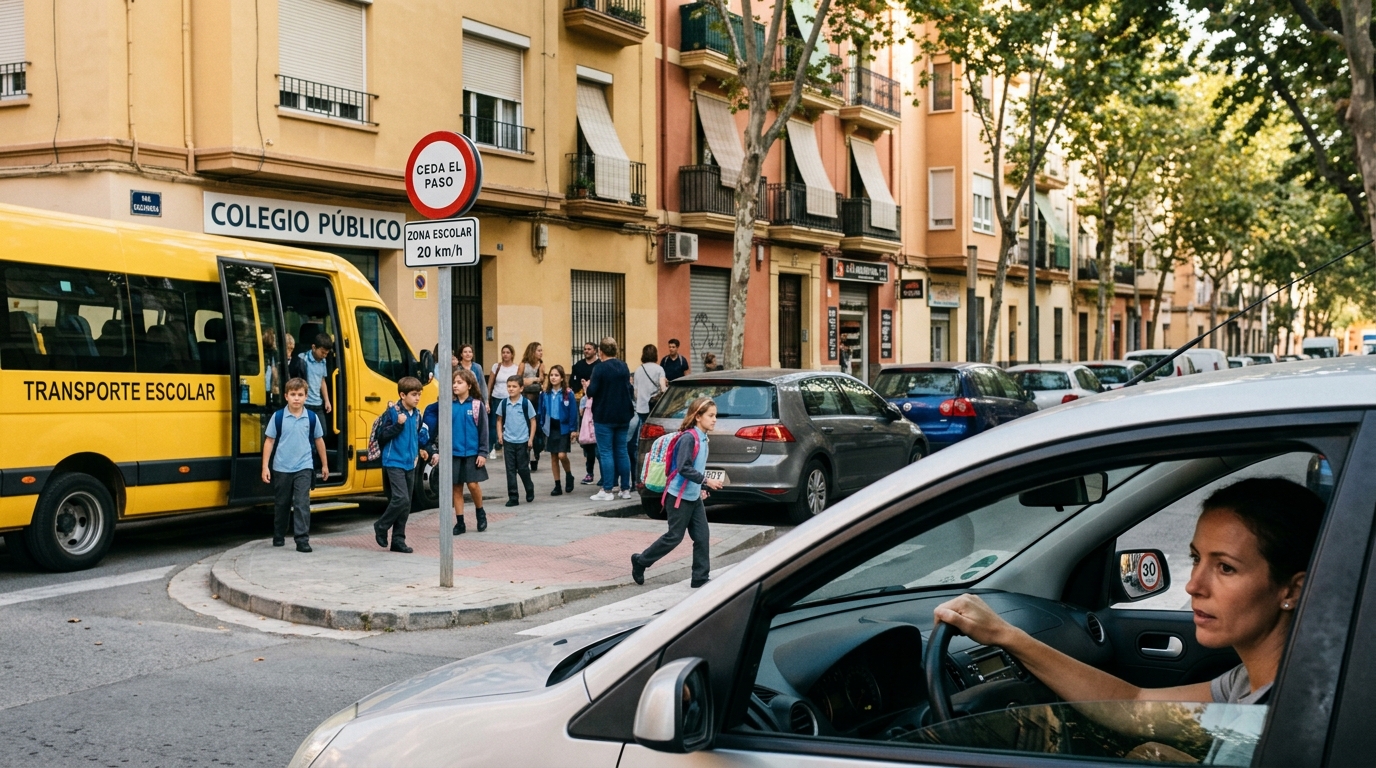

The return to school changes the road environment in more ways than simply adding traffic.
It introduces a particularly vulnerable group of road users into places where vehicles are moving, stopping, turning and manoeuvring.
Children.
And children do not always behave predictably.
That is not a criticism of them.
It is simply a fact of childhood.
A child may see a friend on the other side of the road.
A ball may roll into the carriageway.
A parent may appear unexpectedly.
A child may suddenly decide to run.
The driver needs to anticipate those possibilities.
The driver controls the more dangerous machine
This is perhaps the most important thing to remember.
A child can make a mistake.
A pedestrian can become distracted.
A cyclist can wobble.
A parent can stop unexpectedly.
But the driver is controlling a vehicle weighing hundreds or thousands of kilograms.
The consequences of a mistake are therefore not equal.
That creates a particular responsibility.
It is not about blaming the driver for somebody else’s behaviour.
It is about recognising who has the greater ability to cause serious harm and behaving accordingly.
School buses need particular attention
A school bus creates a very different traffic environment.
Children are getting on.
Children are getting off.
Parents may be waiting.
Pedestrians may be moving around the bus.
Other vehicles may be approaching from behind.
The situation can change within seconds.
The DGT specifically advises drivers not to overtake a school bus while it is stopping to collect or drop off children.
The safest approach is to expect movement rather than assuming that a stationary bus means nothing is happening.
Look beyond the bus
A large vehicle can hide a great deal.
A child standing beside a bus may not be visible.
A pedestrian may emerge from the front or rear.
Another vehicle may be approaching from the opposite direction.
This is why simply seeing the bus is not enough.
Look at what might be happening around it.
Reduce speed.
Increase your observation.
Be prepared to stop.
Children can change direction without warning
Adults tend to think in terms of traffic.
Children often think in terms of destinations.
They see the school.
Their friend.
Their parent.
A football.
Something interesting happening across the road.
The route between those things may not always be the route an adult would choose.
Drivers should therefore avoid relying on children to behave exactly as expected.
Instead, create enough time to deal with the unexpected.
Slow down before the danger appears
One of the problems with school zones is that the greatest danger may not be immediately visible.
If you wait until you see a child in the road before reducing speed, you may already have lost valuable reaction time.
The better approach is to recognise the environment.
School.
Bus stop.
Pedestrian crossing.
Parked cars.
Children.
That combination should automatically make a driver more alert.
Parked vehicles hide people
A row of cars can create a series of blind spots.
A child may be behind one.
A cyclist may be approaching alongside another.
A pedestrian may step between them.
Do not simply watch the vehicle immediately ahead.
Look through gaps where possible and be prepared for movement from concealed areas.
Patience is part of driving
School traffic can be frustrating.
A bus stops.
A parent hesitates.
A child takes longer to cross.
Traffic builds.
But impatience does not make the situation safer.
If anything, it encourages drivers to close gaps, accelerate between hazards and take opportunities that would be better left alone.
There is no prize for being first through a school zone.
Expect the unexpected
Perhaps the simplest rule is also the most useful.
Expect the unexpected.
If you expect a child to run out, you are more likely to be prepared.
If you expect a bus to stop, you are less likely to be surprised.
If you expect a parent to hesitate, you are more likely to leave space.
Anticipation changes the way we drive.
The safest driver is the one who leaves room for mistakes
Nobody on the road is perfect.
Children make mistakes.
Parents make mistakes.
Drivers make mistakes.
The important thing is whether those mistakes have enough space to be corrected without becoming collisions.
Around schools, that space matters enormously.
Slow down.
Look carefully.
Leave room.
Expect movement.
And remember that the person most capable of preventing a serious outcome is often the person behind the wheel.
That is not a burden.
It is the responsibility that comes with controlling the most powerful machine in the environment.
Discover more from N332.es - Driving In Spain
Subscribe to get the latest posts sent to your email.