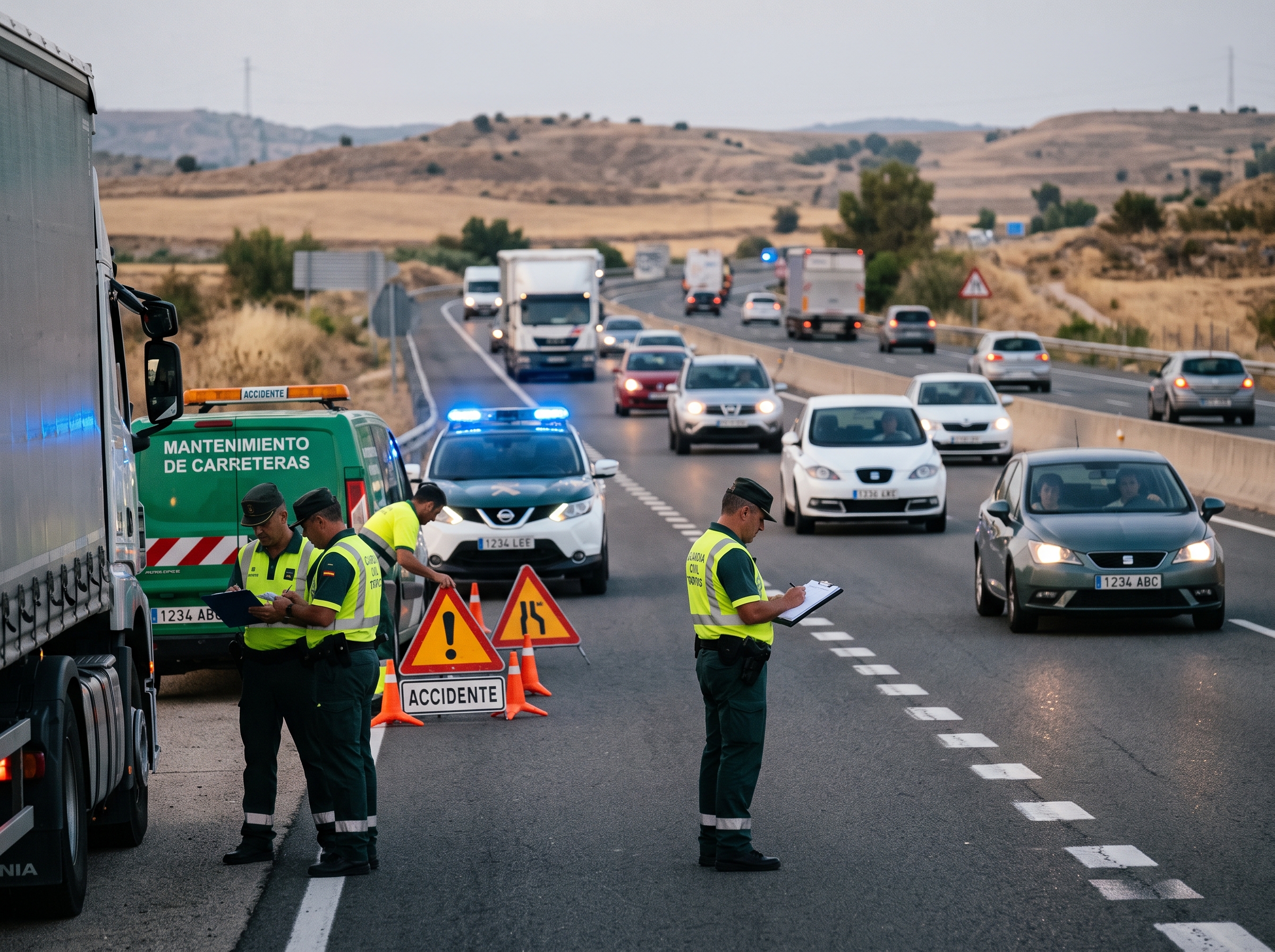

Spain recorded 240 fatalities on intercity roads during July and August 2026, marking a 4% increase over the previous summer despite overall hospital admissions falling by 10%. The figures, presented by Interior Minister Fernando Grande-Marlaska alongside the DGT and the Agrupación de Tráfico de la Guardia Civil, coincided with a record-breaking 102 million long-distance journeys. While motorcyclist deaths dropped significantly to 54, pedestrian and cyclist fatalities increased, and one in five car occupants killed was not wearing a seatbelt. In response to the summer figures, the government confirmed it will reintroduce legislation to reduce the legal driver blood alcohol limit to 0.2 grams per litre of blood.A total of 240 people lost their lives in 218 fatal traffic collisions on intercity roads across Spain during July and August. The figures represent a 4% increase in fatalities compared to the previous summer, even as hospitalisations dropped by 10% to 926. The data was officially presented at the headquarters of the Dirección General de Tráfico (DGT) by the Minister of the Interior, Fernando Grande-Marlaska, accompanied by the Undersecretary of the Ministry, Susana Crisóstomo, and the Director General of Traffic, Pere Navarro.
During the presentation of the Operation Summer 2026 report, Grande-Marlaska confirmed that the government will revive plans to tighten alcohol limits for motorists. He announced that during the upcoming parliamentary session, the ministry will once again promote legislation to reduce the permitted blood alcohol limit for all drivers to 0.2 grams per litre of blood. The minister appealed directly to political groups for cross-party support, arguing that scientific evidence supports the move and that human lives must not be subject to political bargaining.
The summer period saw long-distance road journeys set an all-time record of 102 million trips, rising 1.5% over peak levels. Traffic demand peaked in August with 52.5 million journeys, compared to 49.5 million recorded during July.
Movement on the road network was also heavily conditioned by environmental and natural events. Forest fires in Ávila, Madrid, Castellón, Huelva, and Huesca required continuous intervention from the Agrupación de Tráfico de la Guardia Civil and the DGT. A total of 2,640 kilometres across 227 roads suffered closures due to active blazes, reaching a single-day peak of 850 kilometres of cut roads on 27 July.
To manage fire disruptions, 1,599 officers from the Agrupación de Tráfico de la Guardia Civil carried out 376 access-control operations, established 451 road closures, manned 226 strategic checkpoints for emergency vehicle access, set up diversions, and provided 18 escorts to European assistance teams.
Traffic management also faced an unprecedented surge during the solar eclipse on 12 August. Monitoring covered 2.3 million journeys that day, with peak congestion hitting between 9:00 pm and midnight as observers returned home, driving volume up 25.7% above baseline averages. The official eTraffic portal logged 21.6 million queries on the day, supported by 3,264 safety and guidance warnings broadcast via variable message signs.
Accident distribution over the summer was markedly split. July saw 110 fatalities, marking the third lowest July on record and the second lowest of the past decade. In contrast, August recorded a sharp spike with 130 deaths, making it the third deadliest August in ten years. The single worst day occurred on Thursday, 13 August, when ten people died on Spanish roads.
Conventional secondary roads accounted for the vast majority of tragedies, claiming 175 lives (73% of the total), matching the figure from 2025. Fatalities on motorways and dual carriageways rose to 65, ten more than the previous year. Run-off-road incidents remained the most common lethal collision type, claiming 88 lives, followed by head-on crashes, which caused 54 deaths.
Vulnerable road user deaths decreased by 12% overall, with 92 deaths accounting for 38% of total road victims. Motorcyclist fatalities dropped significantly to 54, down by 18 deaths, marking the first summer since 2014 where the daily motorcyclist death toll fell below one. The decline in motorbike deaths was largely concentrated in Galicia, Andalusia, Madrid, and Catalonia. Despite this progress, half of all deceased motorcyclists were involved in weekend run-off-road crashes on conventional routes.
Pedestrian deaths increased to 26, up by three. Fourteen pedestrians died on motorways and dual carriageways, and twelve were struck on conventional roads, including one road maintenance operative. Crucially, out of 17 pedestrians killed between dusk and dawn, 13 were not wearing mandatory reflective clothing. Cyclist deaths also rose from nine to 12, with three of the victims failing to wear a protective helmet.
Failure to use basic safety restraints remained a major factor in survivability. A total of 25 victims travelling in passenger cars and vans were not wearing seatbelts when their collisions occurred.
By age category, the highest number of fatalities occurred among people aged 45 to 54, with 49 deaths. The 15 to 24 age bracket experienced 31 deaths, an increase of eight.
Regionally, casualty figures varied substantially:
- Andalusia: 38 deaths (down 10)
- Aragon: 13 deaths (up 5)
- Asturias (Principality of): 4 deaths (down 2)
- Balearic Islands: 10 deaths (up 5)
- Canary Islands: 7 deaths (down 4)
- Cantabria: 2 deaths (up 2)
- Castilla-La Mancha: 22 deaths (no change)
- Castile and León: 34 deaths (up 2)
- Catalonia: 19 deaths (down 9)
- Valencian Community: 25 deaths (up 12)
- Extremadura: 10 deaths (up 1)
- Galicia: 17 deaths (down 4)
- Madrid (Community of): 17 deaths (up 5)
- Murcia (Region of): 12 deaths (up 8)
- Navarre (Chartered Community of): 4 deaths (up 2)
- Basque Country: 6 deaths (down 1)
- La Rioja: 0 deaths (down 2)
- Ceuta and Melilla: 0 deaths (no change)
Taking the wider year into perspective, 734 people died on Spanish roads up to 31 August, compared to 750 deaths during the same eight-month period in 2025. This 2% drop keeps overall national accident statistics within the standard 5% margin considered statistically stable by road safety specialists.
Discover more from N332.es - Driving In Spain
Subscribe to get the latest posts sent to your email.