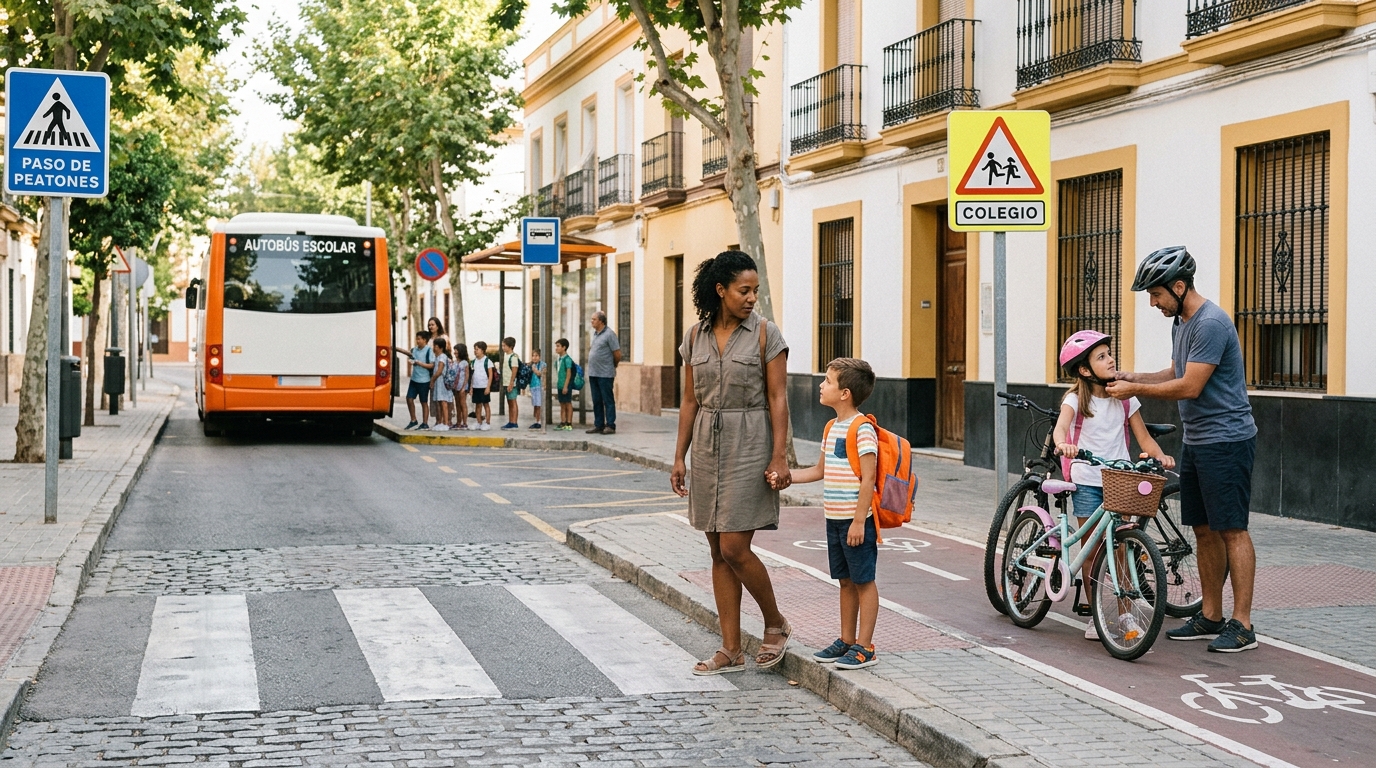

For some families, the school journey begins with a car.
For others, it begins at the front door.
A child might walk.
They might cycle.
They might take a school bus.
They might use public transport.
Whatever the method, there is one constant.
Children are watching the adults around them.
And what they see often teaches them more than what they are told.
Walking is a skill
Walking to school may seem simple to an adult.
For a child, it is an opportunity to develop road awareness.
Where should I cross?
When should I wait?
What do I need to look for?
Can I see clearly between these parked vehicles?
These are skills that develop over time.
Parents can help by practising them rather than simply giving instructions.
Talk about what you see.
Explain why you are waiting.
Point out approaching vehicles.
Show that looking is something we do every time, not just when somebody reminds us.
Don’t teach patience by being impatient
This is particularly important at crossings.
A parent who becomes frustrated because a vehicle has not stopped immediately sends a very different message from one who calmly waits.
Likewise, crossing against a signal because “there’s nothing coming” teaches a child that rules are optional when they appear inconvenient.
Children are exceptionally good observers.
They notice inconsistencies.
Cycling brings another set of lessons
If a child cycles to school, the bicycle itself is only part of the preparation.
The child needs to understand how to interact with other road users.
They need to know where they can safely ride, how to approach junctions and why visibility matters.
Parents should also model the behaviour they expect.
If adults wear appropriate protective equipment and behave predictably, children see that cycling safely is normal rather than something embarrassing or unnecessary.
The DGT’s current safe-school-route programme specifically promotes walking and cycling as safe, active ways for children to reach school.
The school bus is not simply a taxi
For many children, the school bus is part of the daily routine.
That routine still requires responsibility.
Children should know how to approach the bus stop safely, wait appropriately and board without pushing or rushing.
Once aboard, they should remain seated and follow the safety instructions.
The DGT’s school-transport guidance emphasises orderly boarding and leaving, appropriate restraint where provided and respect for designated stopping areas.
Parents have a role even when they are not on the bus
It is easy to assume that once a child gets onto a school bus, responsibility has transferred entirely to somebody else.
It has not.
Parents can ask simple questions.
Where do you wait?
How do you get on?
Where do you sit?
What do you do when you leave the bus?
These conversations help children understand that safety continues throughout the journey.
Respect the bus stop
The DGT specifically advises parents and other drivers to respect school-bus stopping areas and avoid parking in double file or otherwise obstructing them.
That is about more than convenience.
A blocked bus stop can force children to move into a less protected area of the road.
A parent who parks somewhere inappropriate may therefore create a hazard for the very children they are trying to collect.
Good behaviour travels with us
Road safety is not only about avoiding collisions.
It is also about courtesy.
Waiting patiently.
Allowing people to cross.
Giving cyclists space.
Not blocking pavements.
Not stopping where others need to pass.
These behaviours create a safer environment for everybody.
And children learn them by watching.
Let children see you make the right choice
Sometimes the most powerful lesson is remarkably small.
You could cross now, but you wait.
You could squeeze past the cyclist, but you give them space.
You could stop on the corner, but you find somewhere appropriate.
You could rush because you are late, but you remain calm.
Your child may not say anything.
They may not even appear to notice.
But they are learning.
The road user they become starts today
Nobody suddenly becomes a responsible road user on their eighteenth birthday.
The foundations are laid much earlier.
They learn from parents.
Teachers.
Friends.
And the everyday environment around them.
That makes the school journey an opportunity.
Whether your child walks, cycles, takes the bus or travels by car, you can help them develop habits that will stay with them for life.
Because the most valuable road-safety lesson a parent can give is not a lecture.
It is an example worth following.
Discover more from N332.es - Driving In Spain
Subscribe to get the latest posts sent to your email.