For many drivers, the hard shoulder has one simple meaning.
It is the strip of road to the right of the main carriageway, separated by a solid line.
It is not another traffic lane.
It is there for specific purposes.
From 1 October 2026, however, drivers in Spain will see one important change.
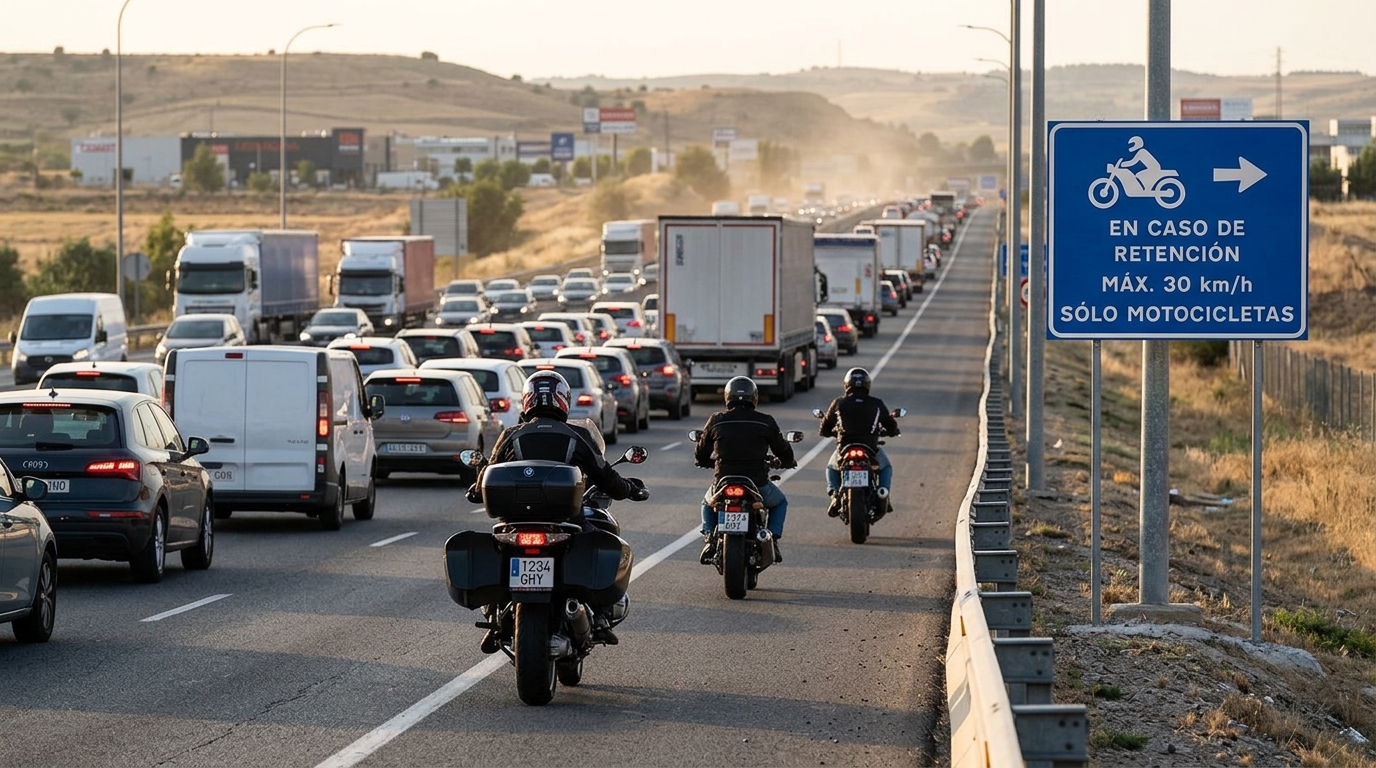
Motorcycles will be permitted to use the right hard shoulder in certain circumstances.
That does not mean that motorcycles can simply use it whenever traffic is slow.
The conditions are very specific.
It is only on designated stretches
The new rule does not give every motorcycle a general right to enter the hard shoulder.
The stretch of road must have been specifically designated by the relevant road and traffic authorities.
It must also be clearly identified by vertical signs and road markings.
If the appropriate signs are not present, the new motorcycle provision does not apply.
That distinction is extremely important.
Drivers should not assume that seeing a hard shoulder means a motorcycle is automatically entitled to use it.
Congestion must have stopped the traffic
There is another essential condition.
The normal traffic lanes must be stopped because of congestion.
The provision is intended to separate motorcycles from stationary or heavily congested traffic and allow them to progress cautiously without filtering through the main lanes.
If traffic is simply moving slowly, that does not automatically mean the hard shoulder becomes available.
The rule is specifically linked to congestion causing the traffic lanes to stop.
The maximum speed is 30 km/h
Even when all the conditions are met, there is a strict speed limit.
30 km/h maximum.
And motorcycles must travel one behind another, rather than side by side.
This is not an opportunity to make rapid progress past a traffic jam.
It is a controlled safety measure.
The speed difference between a motorcycle travelling at 30 km/h and stationary traffic may already be significant.
Keeping that difference as small as possible helps give riders and other road users more time to react.
Motorcyclists must still watch the hard shoulder
The hard shoulder is not necessarily empty.
Other road users may be required to use it.
Vehicles can be stopped there.
A breakdown may have occurred.
An emergency vehicle may need access.
A cyclist or ciclomotor may be using it where permitted or required.
The new regulation specifically states that motorcycle riders must ensure they do not endanger those who are obliged to use the hard shoulder and must leave it if necessary.
That is an important safeguard.
The new right does not override the needs of other users.
Motorcycles and ciclomotores are not the same
This is probably the biggest potential source of confusion.
A ciclomotor is already required to use the right hard shoulder where it is passable and sufficient, unless there is a dedicated part of the road for it.
That remains the rule.
The new provision for motorcycles is completely different.
It is an extraordinary, conditional permission allowing motorcycles to use the hard shoulder during specified congestion situations on designated stretches.
The two rules should not be confused.
Ciclomotores have their own speed limit
Ciclomotores are also subject to their own maximum speed.
They cannot travel faster than 45 km/h.
That does not mean they should necessarily travel at 45 km/h in every situation.
Like every other road user, they must adapt speed to the road, traffic and conditions.
What about everybody else?
For the ordinary driver, perhaps the most important message is that nothing has suddenly changed about the general purpose of the hard shoulder.
It remains an area with specific uses.
It can be used by vehicles that are required or authorised to travel there.
It can provide space for emergencies.
And under the new rules, when traffic becomes congested on certain designated roads, motorcycles may use it under the conditions described above.
That is very different from treating it as an additional lane whenever traffic is inconvenient.
If an emergency vehicle needs to pass
There is another situation every driver should understand.
If an emergency vehicle needs to get through congested traffic, other vehicles may need to move to create an emergency corridor.
But this must be done carefully.
Drivers should not simply move onto the hard shoulder without checking what is there.
A hard shoulder can contain a stationary vehicle, a vulnerable road user or a motorcycle using it legally.
Look first.
Move only when it is safe and appropriate.
A new rule does not remove the need for judgement
One of the risks with any change to road law is that people remember the headline but forget the conditions.
“Motorcycles can use the hard shoulder.”
That statement is incomplete.
The actual rule is much more precise.
Designated stretch.
Clear signage and markings.
Traffic lanes stopped because of congestion.
Maximum 30 km/h.
Single file.
Do not endanger other hard-shoulder users.
Those conditions are what make the new arrangement work.
The aim is separation, not speed
The purpose of the change is not to give motorcycles a faster route through traffic.
It is to separate a vulnerable group from stationary vehicles where the conditions have been specifically designed to permit it.
That distinction matters.
A motorcycle is much more exposed than a car occupant.
Separating it from dense stationary traffic can reduce certain risks.
But only if the motorcycle is travelling cautiously and everyone understands what is happening.
The hard shoulder is still not a shortcut
For drivers, motorcyclists and everyone else, the principle remains straightforward.
Use the road space you are legally entitled to use.
Understand the signs.
Follow the conditions.
Look for vulnerable road users.
And never assume that an empty-looking strip of tarmac is automatically available simply because the main carriageway is busy.
From October, motorcycles will have a new option in carefully controlled circumstances.
It is a useful change.
But like every road-safety measure, its success will depend on people understanding not just what they are allowed to do, but when and how they are allowed to do it.
Discover more from N332.es - Driving In Spain
Subscribe to get the latest posts sent to your email.